Grouper is less a single fish than a family of them. The groupers, family Epinephelidae, include well over a hundred species, from plate-size reef fish to the giant grouper, which can pass 2.5 m. A handful of Asian Epinephelus species, most of them farmed, make up the bulk of the frozen grouper offered by Asian packers. Our frozen grouper page lists the species, sizes and forms we supply.
This profile covers grouper biology, the species buyers meet most often and how to recognize them, the Chinese names that carry the live trade’s vocabulary, where farmed fish come from, and the labeling and legal points that follow from selling a whole family under one name.
Key takeaways
- Grouper covers well over a hundred species; most frozen grouper from Asia is farmed orange-spotted, tiger, giant or hybrid Epinephelus.
- Groupers usually mature as females and some later become males, the reverse of barramundi; slow growth and spawning aggregations leave wild stocks vulnerable.
- Chinese trade names such as 青斑, 老虎斑, 龍躉 and 東星斑 separate species that English names blur, and “tiger grouper” means different fish in Asia and the US.
- Order by scientific name, keep fillets skin-on where possible, and check catch documents, residue tests and ciguatera risk as they apply.
What groupers are and how they live
Groupers are heavy-bodied, big-mouthed predators of warm coastal reefs, rocky ground and estuaries. Most wait near caves, ledges or coral heads and engulf their prey whole; FishBase records the giant grouper (Epinephelus lanceolatus) eating spiny lobsters, small sharks and rays, and even young sea turtles. Older references place groupers in the sea bass family, Serranidae, while FishBase and other current catalogs treat them as a family of their own.
Most groupers are protogynous hermaphrodites: they mature as females and some later change into males. In orange-spotted grouper, FishBase records first maturity at about 25 to 30 cm and sex change at 55 to 75 cm. Barramundi does the opposite, as the barramundi species guide describes. Many groupers grow slowly, live long and gather at predictable sites to spawn, all of which make wild stocks easy to overfish, and FishBase rates the giant grouper’s vulnerability to fishing as very high.
That biology helps explain why farming now supplies much of the grouper sold live in Hong Kong and southern China and most of the frozen grouper from Asian packers. Hatcheries in the region produce fingerlings of several species, and growers raise them in floating sea cages and coastal ponds.
The grouper species buyers meet most often
| Species | Chinese trade name | How to recognize it | Place in trade |
|---|---|---|---|
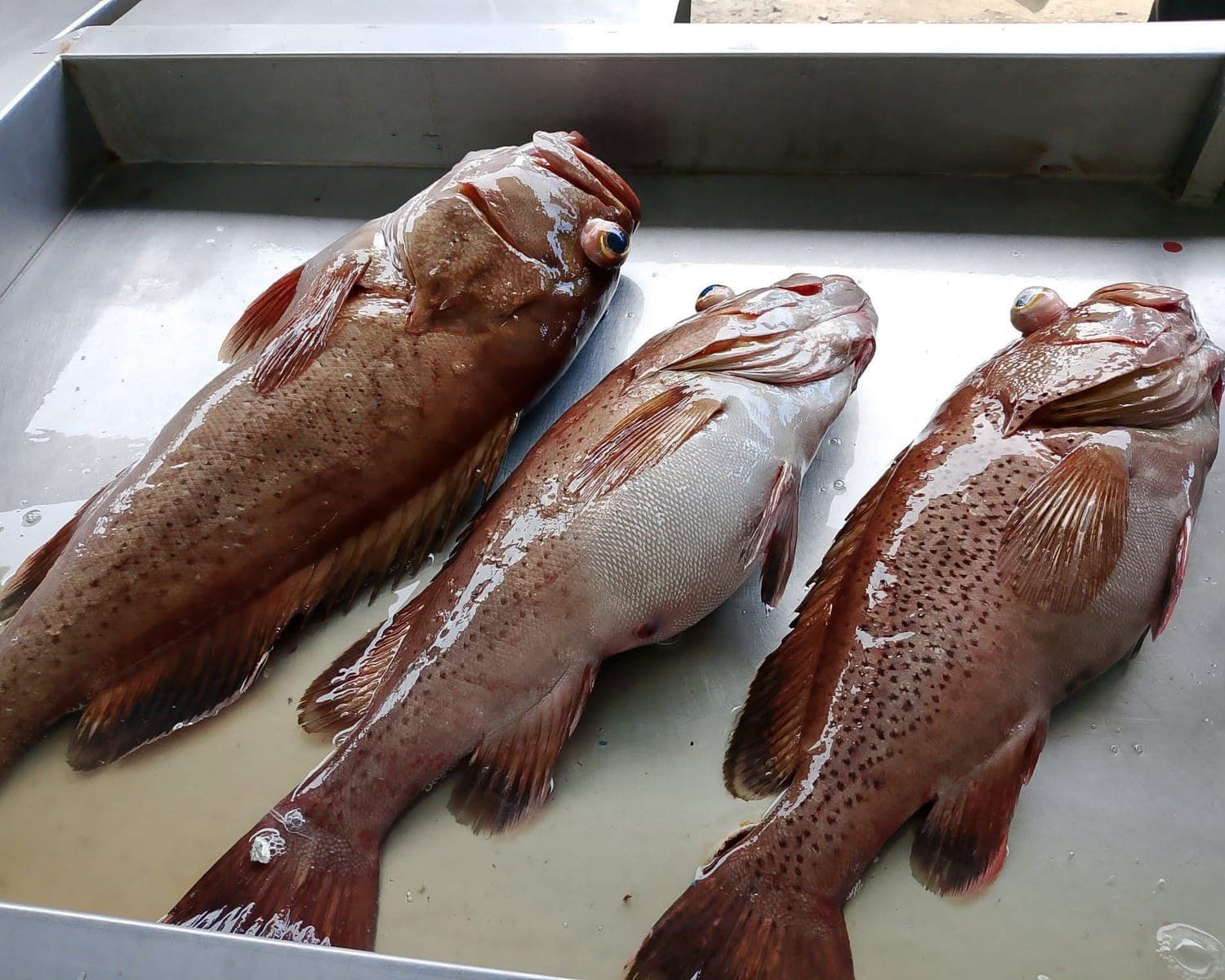
| Orange-spotted grouper, Epinephelus coioides | 青斑 | Tan above, whitish below, covered in small orange-brown spots, with faint dark bars and saddles | Widely farmed; plate-size whole fish |
| Brown-marbled or tiger grouper, E. fuscoguttatus | 老虎斑 | Pale yellowish brown with rows of irregular dark blotches, fine brown spots and a small black saddle on the tail base | Farmed and wild; mother species of the hybrid |
| Giant grouper, E. lanceolatus | 龍躉 | Juveniles yellow with black patches; adults dark brown with small black spots on the fins | Farmed to large sizes for fillets and hot-pot slices |
| Hybrid grouper, E. fuscoguttatus × E. lanceolatus | Names vary by market | Marbled pattern like the tiger parent on a heavier, faster-growing body | Among the most common farmed groupers; sabah or pearl grouper |
| Leopard coral grouper (coral trout), Plectropomus leopardus | 東星斑 | Red to orange-brown, covered in small blue spots | A leading species in the live reef fish trade |
| Humpback grouper, Chromileptes altivelis | 老鼠斑 | Pale with widely spaced round black spots, a small head and a humped back | Sold live in Hong Kong; juveniles also in the aquarium trade |
Skin pattern is the main field mark, and it changes with age: orange-spotted grouper spots darken and fade as the fish grows, and giant grouper look nothing like their yellow-and-black juveniles. FishBase also notes that orange-spotted grouper is frequently misidentified as E. tauvina or E. malabaricus, and that tiger grouper is often confused with E. polyphekadion. The humpback grouper’s genus is spelled Chromileptes in the current scientific catalogs, but Cromileptes remains in common use.
Grouper names in Hong Kong, South-East Asia and the US
Chinese names dominate grouper vocabulary because Hong Kong and southern China are the main centers of the live trade. 石斑 is the general word for grouper, and individual species carry their own names, shown in the table above. In Malaysia and Indonesia grouper is kerapu, in the Philippines lapu-lapu and in Vietnam cá mú.
English names are less consistent. “Tiger grouper” means E. fuscoguttatus in Asian trade, but on the US FDA Seafood List it is the common name of Mycteroperca tigris, an Atlantic species, while E. fuscoguttatus appears there as mottled grouper. The humpback grouper is also called barramundi cod, although it has nothing to do with barramundi. On the US FDA list, “grouper” is the acceptable market name for nearly all of the Epinephelus, Mycteroperca and Plectropomus species, some with an alternative such as gag, and the hybrid may also be sold as hybrid tiger or giant grouper, so the scientific name has to carry the detail.
Where grouper comes from
Farmed grouper comes mainly from Indonesia, Malaysia, Vietnam, the Philippines, Thailand, Taiwan and southern China, much of it destined for live markets in Hong Kong and mainland China. Orange-spotted grouper is one of the most widely farmed species, while giant grouper and the tiger × giant hybrid have grown in importance because they reach large sizes quickly. Farmed fish are harvested all year; demand peaks around Lunar New Year and the banquet seasons of Chinese communities.
Wild groupers are taken by hook and line, traps and spear across the tropics. In the United States, the domestic groupers are Atlantic species such as red grouper (E. morio) and gag (Mycteroperca microlepis) from the Gulf of Mexico and South Atlantic, landed by fisheries managed with quotas, size limits and seasonal closures. Live reef fish from South-East Asia move mainly through Hong Kong, and part of that trade continues on to mainland China.
Live, fresh and frozen grouper in the kitchen
Grouper’s most valued form is the live fish in a restaurant tank. In Hong Kong and southern China, diners choose a fish that is killed and steamed to order, and coral trout, humpback grouper and giant grouper are among the most prized choices. Frozen grouper serves the kitchens and markets the live trade cannot reach: whole fish frozen singly for steaming, skin-on fillets, steaks and thin slices for hot pot. Chinese cooks prize the thick skin, which turns gelatinous when steamed, so fillets normally keep it.
- Cantonese steamed whole grouper, finished with scalding oil, soy sauce, ginger and spring onion; plate-size orange-spotted or hybrid fish are typical.
- Hot pot and congee with thin slices from large giant or hybrid grouper.
- Southern United States: grilled, blackened or fried fillets, and the Florida grouper sandwich.
- South-East Asia: whole fish fried with sweet-sour or chili sauce, and fillets in curries and soups.
Grouper flesh is firm, white and lean, with a mild, clean flavor and large flakes that hold together in steaming, frying and stews. Buyers who need a similar plate-size fish at a different cost often compare frozen red snapper and frozen barramundi; the red snapper species guide explains that fish’s naming issues. Grouper also appears beside frozen abalone on Chinese banquet menus.
Labeling, substitution and legal notes for grouper
Because one market name covers so many species, grouper is a target for substitution, especially as skinless fillets, where the pattern that identifies the species is gone. Keeping the skin on is the simplest safeguard, since the pattern stays visible; for skinless product, rely on a DNA test of the first lots from any new packer.
- Catch documents: wild-caught grouper shipped to the EU needs a catch certificate under the EU rules against illegal fishing, and grouper is one of the species groups in the US Seafood Import Monitoring Program, so US importers should confirm what reporting applies to their lots.
- Residues: farmed grouper is subject to border testing for veterinary drugs and banned substances in most importing markets.
- Conservation status: several groupers are assessed as threatened on the IUCN Red List, among them the tiger grouper, rated Vulnerable in its 2016 assessment. Check the current CITES and national status of any wild reef species before trading it.
- Ciguatera: large wild groupers from some reef areas can carry ciguatoxins, which cooking does not destroy; FishBase flags the risk for giant and tiger grouper, so the fishing area of wild lots matters.
Our reefer shipping guide covers holding temperatures and Incoterms for frozen grouper, and the guide to choosing premium seafood ingredients explains how to judge cost per plated portion. To match a grouper species and size to your menu, request an offer from our team.
This guide is general trade information, not legal or regulatory advice. Requirements differ by market and change over time; confirm current rules with your customs broker or competent authority before ordering.