Barramundi (Lates calcarifer) goes by more names than most farmed fish: Asian sea bass, giant sea perch, pla kaphong khao in Thailand, siakap in Malaysia and bhetki in Bengal. Behind them all is a large predatory perch of Indo-West Pacific coasts, rivers and estuaries, and the barramundi in commercial trade today is mostly farmed. Our frozen barramundi page sets out the forms, size grades and farming origins we offer.
The sections below explain how barramundi lives in the wild, why it farms well in fresh, brackish and sea water, where supply comes from, and how it compares with the other fish that share its names. They close with market forms, cooking traditions and the points that matter most when comparing suppliers.
Key takeaways
- Barramundi, Asian sea bass and giant sea perch are names for one species, Lates calcarifer, which is neither European sea bass nor Chilean sea bass.
- It moves between rivers and estuaries in the wild and changes from male to female as it grows, which lets farms raise it in fresh, brackish or sea water.
- Farming started in Thailand in the 1970s; Thailand and Malaysia are among the largest producers, and farmed barramundi is harvested all year.
- Buy plate-size whole fish for steaming and frying and skin-on fillets for crisp-skinned dishes, and taste cooked samples from each new farm.
What barramundi is: names and close relatives
Barramundi belongs to the family Latidae, a small group of large perch-like fishes. The name is a loanword from an Aboriginal language of the Rockhampton area in Queensland, usually translated as “large-scaled river fish”, and it is thought to have referred first to the saratogas, unrelated freshwater fish. The name was taken up for marketing Lates calcarifer in the 1980s, while Asian sea bass remains the usual name in Asian trade.
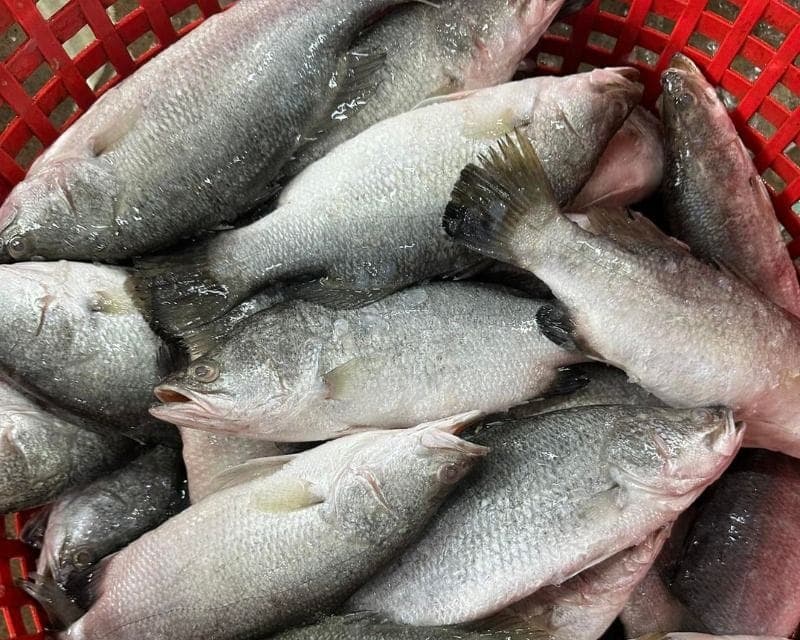
A whole barramundi is easy to recognize: an elongated, compressed body with a thick tail base and a rounded tail fin; large scales; a dorsal fin deeply notched between its spiny and soft parts; and a large, slightly oblique mouth whose upper jaw reaches back behind the eye. The lower edge of the preopercle, the front bone of the gill cover, carries a strong spine. FAO describes two color patterns, olive brown above with silver sides and belly, usually in juveniles, or green to blue above and silver below; in both, the body and fins carry no spots or bars.
Two relatives are worth knowing. Nile perch (Lates niloticus) is an African freshwater cousin, introduced to Lake Victoria in the 1950s, where it displaced many native fish and became the basis of a fillet export industry in Uganda, Kenya and Tanzania; its US market name is Nile perch, not barramundi. Japanese lates, or akame (Lates japonicus), lives only in a few rivers and estuaries on Japan’s Pacific coast and was described as a separate species in 1984. In 2012 scientists also named two narrowly distributed species from Sri Lanka and Myanmar, L. lakdiva and L. uwisara, that had previously been counted as barramundi; neither matters to the frozen trade.
| Market or language | Name | Notes |
|---|---|---|
| United States, Australia | Barramundi | The FDA Seafood List gives barramundi as the acceptable US market name |
| International trade | Asian sea bass, giant sea perch | Plain “sea bass” misleads where it means the European fish |
| Thailand | Pla kaphong khao | “White kaphong”, as distinct from the red snapper, pla kaphong daeng |
| Malaysia | Siakap | Everyday market name |
| Indonesia | Kakap putih | Literally “white kakap” |
| Philippines | Apahap | Used in Philippine markets |
| Vietnam | Cá chẽm | Used in Vietnamese markets |
| West Bengal and Bangladesh | Bhetki; koral | Bhetki in Bengali cooking, koral also used in Bangladesh |
| China | 尖吻鲈, 金目鲈 | Standard and market names in Mandarin |
Barramundi biology: estuaries, rivers and a change of sex
Wild barramundi range from the eastern edge of the Persian Gulf through South and South-East Asia to southern China, Taiwan, southern Japan, Papua New Guinea and northern Australia. Larvae and young juveniles grow up in brackish coastal swamps, older juveniles push into the upper reaches of rivers, and adults move back downstream to spawn in estuaries and around river mouths. This life between fresh and salt water explains the species’ wide tolerance of salinity, and it is why farmers can raise barramundi in freshwater ponds, brackish ponds or floating sea cages.
The other unusual trait is sex change. Barramundi are protandrous hermaphrodites: most mature first as males and, after one or more breeding seasons, turn into females, so the largest fish in a wild population are usually female. In Australian populations the switch typically comes at six to eight years and 85 to 100 cm, while FAO notes that sex change in Asian populations is less well defined and that fish maturing directly as females are common there. Barramundi can live for decades, and FishBase records a maximum of 200 cm and 60 kg. Groupers do the reverse, starting as females, as the grouper species guide explains.
Northern Australia still has commercial wild fisheries for barramundi, but nearly all the fish in international trade comes from farms.
Where farmed barramundi comes from
Barramundi farming began in Thailand in the 1970s and spread across South-East Asia. Recent FAO data put Thailand and Malaysia at the top, with Saudi Arabia and Taiwan among the other major producers and further farming in Indonesia, Vietnam, the Philippines, India and Australia. FAO also notes indoor recirculating systems in southern Australia and the northeastern United States.
Most Asian barramundi is grown in floating net cages in coastal bays and estuaries, often on small farms, and the rest comes from ponds. FAO puts grow-out at six months to two years depending on target size, with harvests between about 350 g and 3 kg. Asian markets buy most fish at around 500 to 900 g, while Australian farms split output between plate-size fish of about 350 to 500 g and fillet fish of 2 to 3 kg. Because harvests run continuously, farmed barramundi has no real season, and supply planning revolves around fish size rather than months.
Barramundi vs European sea bass, Chilean sea bass and Nile perch
Calling barramundi “sea bass” causes most of the confusion in its trade. European sea bass (Dicentrarchus labrax), sold as branzino, is a smaller fish of a different family, Moronidae, farmed mainly around the Mediterranean, with a finer, more delicate flake. Chilean sea bass is a marketing name for Patagonian toothfish (Dissostichus eleginoides), an oily, white-fleshed fish of deep Southern Ocean waters. Neither is related to barramundi.
| Fish | Scientific name | Where it comes from | Typical trade form |
|---|---|---|---|
| Barramundi (Asian sea bass) | Lates calcarifer | Indo-West Pacific estuaries and rivers; widely farmed | Plate-size whole fish, skin-on fillets, portions |
| Nile perch | Lates niloticus | African lakes and rivers, notably Lake Victoria | Skinless fillets |
| European sea bass (branzino) | Dicentrarchus labrax | Northeast Atlantic and Mediterranean; mostly farmed | Whole fish and fillets |
| Chilean sea bass | Dissostichus eleginoides | Deep Southern Ocean; wild-caught | Frozen loins and portions |
| Japanese lates (akame) | Lates japonicus | A few rivers and estuaries in Japan | Rarely traded |
Skinless Nile perch fillets look enough like barramundi fillets that the scientific name and, in case of doubt, a DNA test are the only dependable checks; a skin-on fillet keeps more identifying features. On the menu, barramundi competes with snapper and grouper for the same plates, and the red snapper species guide explains how that name is used.
Market forms and how kitchens cook barramundi
Barramundi has firm, moist white flesh with large flakes and a mild, slightly sweet flavor, and its skin crisps well when cooked skin-side down. Those qualities make it adaptable: the same fish works steamed whole in Bangkok, pan-seared in a Sydney bistro or simmered in a Kolkata curry.
- Whole plate-size fish, roughly 300 to 800 g, for steaming, frying and grilling: Thai pla kaphong neung manao is steamed in a sharp lime, garlic and chili broth, and Chinese kitchens steam it with ginger, spring onion and soy.
- Skin-on fillets from larger fish for crisp-skinned, pan-roasted dishes, a favorite restaurant presentation in Australia.
- Skinless fillets and portions for curries, battered fish, retail freezer packs and ready meals.
- Bengali dishes: bhetki fillets are crumbed and fried for the Kolkata fish fry, or wrapped in banana leaf with mustard paste and cooked as bhetki paturi.
Good frozen barramundi shows white to faintly pink, translucent flesh with no yellow tinge in the fat, and skin-on fillets should be completely free of scales. A cooked tasting remains the simplest screen for off-flavor. Our reefer shipping guide covers temperature records and Incoterms for frozen fish programs.
Labeling and trade notes for barramundi
Since barramundi is farmed in many countries, expect retail labels to carry the species name, the farming country and the production method. In markets where “sea bass” means Dicentrarchus labrax, using it alone for barramundi risks a misleading label, so use barramundi or Asian sea bass with the scientific name. Farmed fish entering most markets are subject to residue monitoring for veterinary drugs, and some importing countries limit whole, ungutted fish on biosecurity grounds, so check the planned form against the destination’s rules before ordering.
For comparing offers on usable yield and consistency, see our guide to choosing premium seafood ingredients. Barramundi often shares a reefer load with frozen grouper and snapper. Once you know the size and form you need, ask us for a barramundi offer.
This guide is general trade information, not legal or regulatory advice. Requirements differ by market and change over time; confirm current rules with your customs broker or competent authority before ordering.