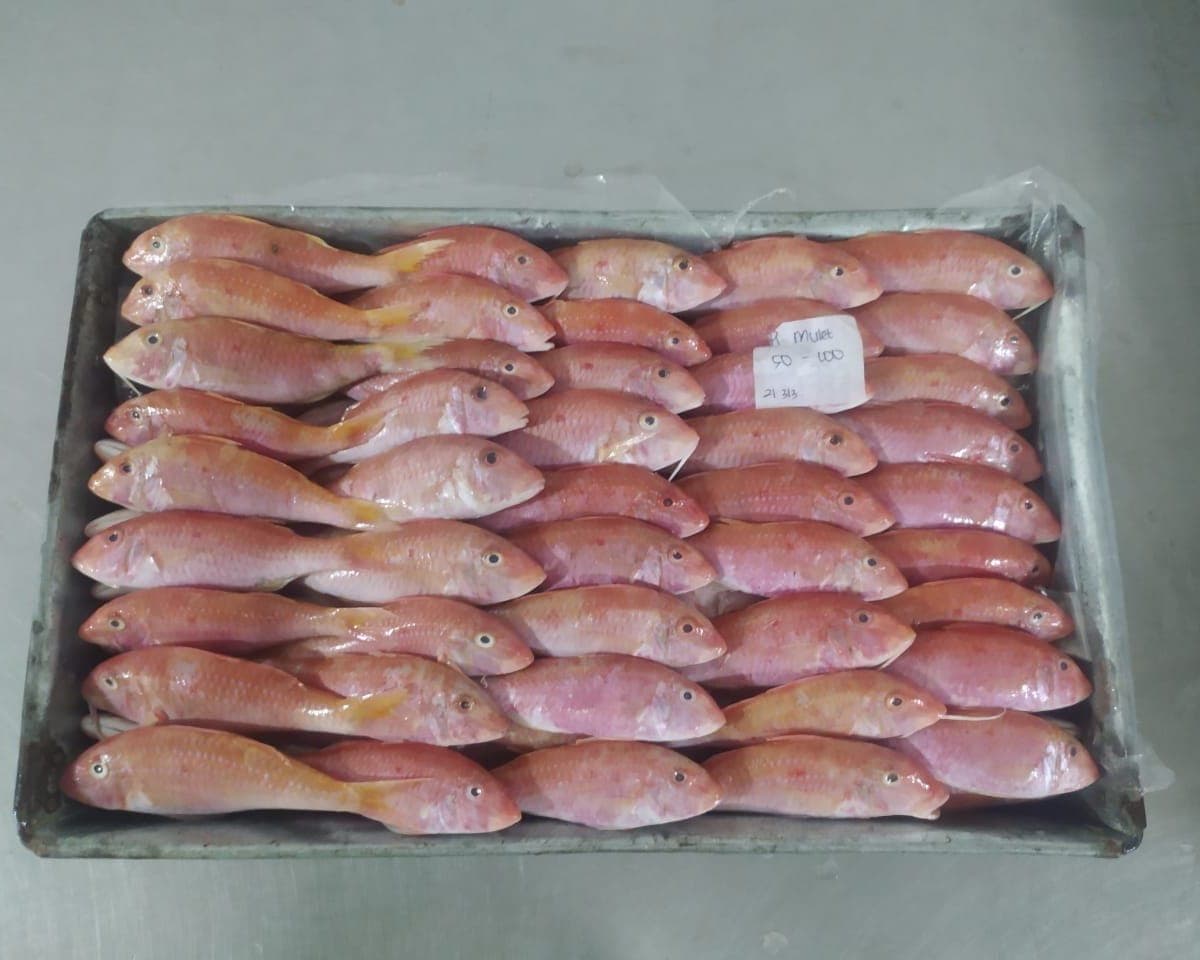
Red mullet is the English name for two small bottom-dwelling fishes of the Mediterranean and eastern Atlantic: the plain red mullet (Mullus barbatus) and the striped red mullet or surmullet (Mullus surmuletus). Both belong to the goatfish family, Mullidae, named for the pair of barbels under the chin that the fish use to search the seabed for food. Our frozen red mullet and goatfish page lists the species, grades and formats we offer.
This profile covers how to tell the two Mullus species apart, their names in the Mediterranean markets that value them most, the Indo-Pacific goatfish often traded under the same English name, and why red mullet has nothing to do with gray mullet. It ends with market forms, classic dishes and the trade rules that apply to a wild-caught fish.
Key takeaways
- Red mullet means Mullus barbatus, the mud-bottom species, and Mullus surmuletus, the striped rock species, both wild-caught in the Mediterranean, Black Sea and eastern Atlantic.
- Tell them apart by forehead profile, first dorsal fin markings and flank stripes, not by color or local market name.
- Indo-Pacific Upeneus goatfish is a smaller relative often traded as red mullet, while gray mullet is an unrelated fish.
- Red mullet is sold whole for frying and grilling, and the scientific name belongs on every specification and label.
Red mullet and the goatfish family
Goatfishes live over sand, mud and rubble in warm and temperate seas. They feed on worms, small crustaceans and mollusks, which they find by sweeping their chin barbels through the sediment, and when the fish are not feeding the barbels fold back into a groove under the chin. Large red mullet was a celebrated luxury in ancient Rome, and the two Mullus species remain among the most esteemed small fish of Mediterranean cooking.
Both species range through the eastern Atlantic, roughly from Norway and the British Isles south to Senegal, and through the Mediterranean into the Black Sea. M. barbatus favors mud, sand and gravel bottoms of the continental shelf, while M. surmuletus prefers rough, rocky or broken ground, mostly shallower than 100 m, though it also occurs over sand. French, Italian and Spanish names preserve that difference, calling one the mud mullet and the other the rock mullet.
They are small fish. M. barbatus is commonly about 20 cm long, and FishBase gives a maximum of 38 cm and 680 g. M. surmuletus grows a little larger, to 40 cm and about 1 kg, and can live 11 years; it spawns from May to July, releasing eggs that drift in open water, as its larvae do.
How to tell Mullus barbatus from Mullus surmuletus
- Head profile: M. barbatus has a steep, almost vertical forehead; M. surmuletus has a longer, more gently sloping snout.
- First dorsal fin: plain in M. barbatus; marked with dark bands or blotches in M. surmuletus.
- Flanks: M. surmuletus shows red and brown stripes running along the body, while M. barbatus is a more uniform pink-red.
- Catch and value: mud-dwelling M. barbatus comes mainly from bottom trawlers, while rock-dwelling M. surmuletus is more often caught by small boats with gillnets and trammel nets and is usually valued more highly.
Color alone is unreliable, because both species fade after death and with rough handling. Check the dorsal fin and the head profile instead. Market names are no more reliable, because vendors often apply them loosely.
| Language | Mullus barbatus (mud bottoms) | Mullus surmuletus (rocky ground) |
|---|---|---|
| English | Red mullet | Striped red mullet, surmullet |
| French | Rouget de vase | Rouget de roche |
| Italian | Triglia di fango | Triglia di scoglio |
| Spanish | Salmonete de fango | Salmonete de roca |
| Portuguese | Salmonete-da-vasa | Salmonete-legítimo |
| Greek | Koutsomoura | Barbouni |
| Turkish | Barbunya | Tekir |
Red mullet vs gray mullet and Asian goatfish
Despite the shared word, red mullet and gray mullet are not related. Gray mullets such as the flathead gray mullet (Mugil cephalus) belong to a different family, Mugilidae: silvery, torpedo-shaped schooling fish of coasts and estuaries that graze on algae and detritus and have no chin barbels. Their salted and pressed roe becomes bottarga, and the gray mullet species guide covers them in detail. In English, “mullet” on its own usually means a gray mullet, so orders, price lists and menus should say red mullet in full.
The closer look-alike is a cousin. Indo-Pacific goatfishes of the genus Upeneus, such as the goldband goatfish (U. moluccensis) and sulphur goatfish (U. sulphureus), school over muddy coastal bottoms, are landed in trawl catches across South and South-East Asia, and are often sold in Asian trade as red mullet. They share the family with Mullus but make a different product: smaller, typically under about 20 cm, silvery-rose rather than red, with a yellow or gold stripe along the flank and a dark tip to the first dorsal fin. The goldband goatfish has also entered the eastern Mediterranean through the Suez Canal, so mixed catches occur there.
| Fish | Family | Key features | Main use in trade |
|---|---|---|---|
| Red mullet, Mullus barbatus | Mullidae | Steep forehead, plain first dorsal fin, pink-red body, chin barbels | Whole fish for frying and grilling in Mediterranean markets |
| Striped red mullet, M. surmuletus | Mullidae | Sloping snout, banded first dorsal fin, stripes along the flank | Higher-value whole fish for grilling, and fillets |
| Goatfish, Upeneus spp. | Mullidae | Smaller, silvery-rose, yellow or gold lateral stripe, dark-tipped first dorsal fin | Everyday frying fish and curries in Asia; sold as red mullet in some trade |
| Gray mullet, Mugil cephalus | Mugilidae | Silvery, cylindrical body, broad flat head, no barbels | Whole fish, fillets and roe for bottarga |
Where red mullet comes from
Red mullet is wild-caught; rearing trials with Mullus have not led to commercial farming of either species. M. barbatus is a staple of Mediterranean and Black Sea bottom-trawl fisheries, and M. surmuletus is taken by trawlers and by small-scale boats setting gillnets and trammel nets, especially over rocky ground. Boats from Turkey, Italy, Greece, Spain and North African countries are among those that land both species, and smaller catches come from Europe’s Atlantic coasts.
Management varies by country. In EU Mediterranean waters the minimum conservation reference size for Mullus is 11 cm, bottom trawling is barred close to the shore, and several member states add seasonal trawl closures; the General Fisheries Commission for the Mediterranean coordinates measures across the basin. Non-EU states set their own rules, so ask which size limits and closed seasons apply to the origin you buy from.
Because fresh landings follow the fishing calendar, importers use frozen red mullet to keep the fish on offer between seasons. Asian goatfish, by contrast, comes ashore as part of the mixed trawl catch in the Gulf of Thailand, the Andaman Sea and neighboring waters.
Cooking red mullet: market forms and classic dishes
Red mullet is almost always sold whole, either whole round or cleaned (scaled, gutted and gilled), because the fish is small and its skin color is part of the presentation. Trade grades run by fish weight, commonly from about 50 g to 300 g per fish; goatfish seldom grows large enough for the top grades, so those are Mullus. The smallest fish are usually fried whole, and larger ones are grilled or filleted in the kitchen. The flesh is white and delicate, with a fuller, more savory flavor than most small white fish, and many Mediterranean cooks leave the liver in because it adds to the taste.
- Fried: small fish dusted in flour and fried whole, as in Greek barbounia tiganita and Turkish barbunya tava.
- Grilled: larger fish cooked whole over charcoal and finished with olive oil and lemon.
- Braised: triglie alla livornese, a Tuscan dish of red mullet cooked in tomato sauce with garlic and parsley.
- Pan-fried fillets: cooked skin-side down in French and modern European restaurant cooking.
- Goatfish in Asia: fried whole or simmered in curries and sour soups.
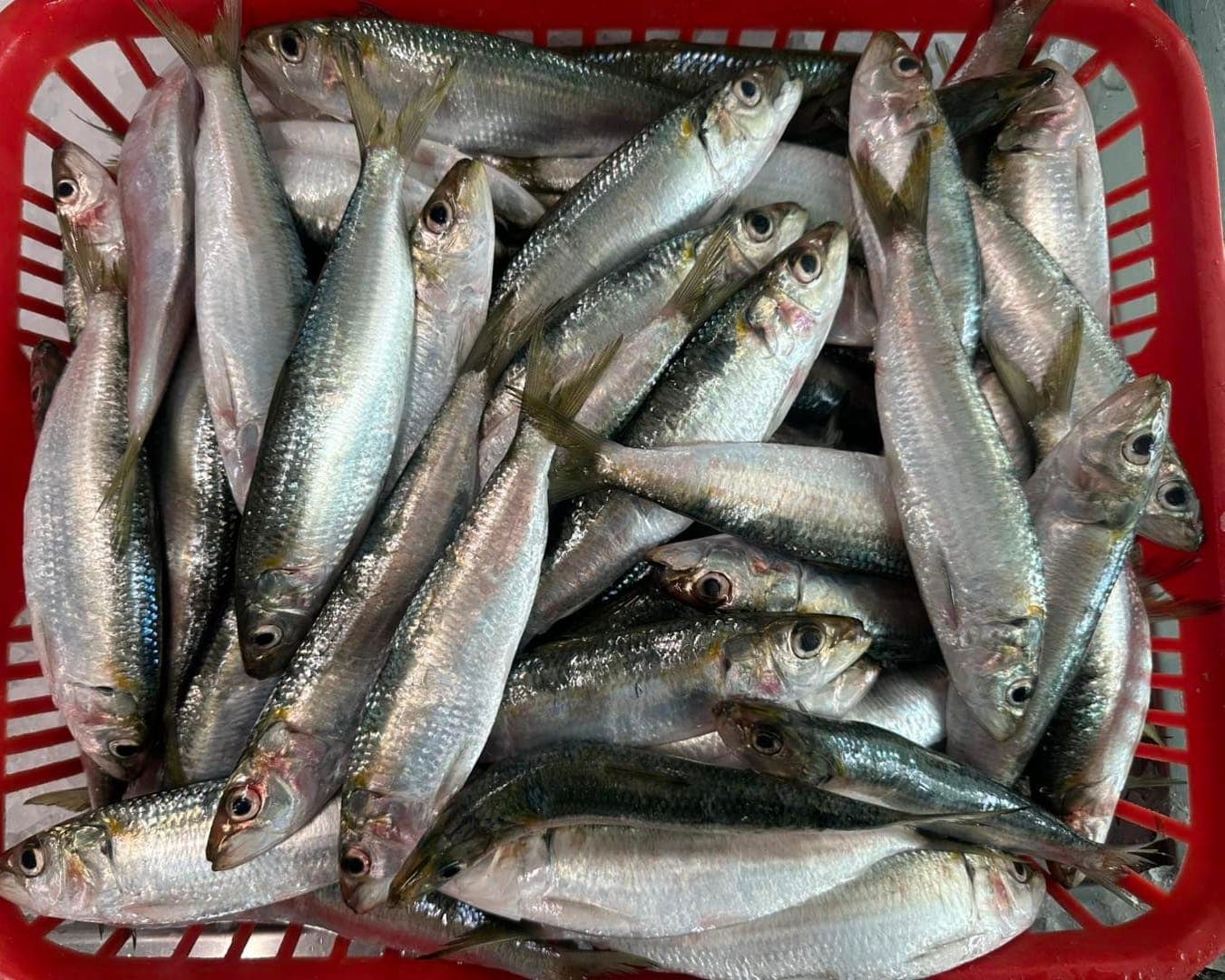
The large scales come away easily and the skin bruises, so red mullet shows rough handling quickly; good frozen fish keep a bright, even color, most of their scales, an intact belly and clear eyes. Importers often fill a container of small whole fish by pairing red mullet with frozen sardines, and the reefer shipping guide explains how frozen loads are held at temperature. For plate-size red fish from Asian waters, see the red snapper species guide.
Labeling and trade notes for red mullet
The English name causes most of the trade problems. In the EU, labels must carry the commercial designation accepted in the member state together with the scientific name, which keeps Mullus and Upeneus apart; in other markets, make the genus part of the specification and confirm the label name with the destination authority. Wild-caught lots for the EU travel with a catch certificate validated by the flag state, and the label also shows the catch area and gear category.
Our guide to choosing premium seafood ingredients explains how to run side-by-side trials before switching suppliers. If you know the species and grade you want, our team can prepare a red mullet or goatfish offer.
This guide is general trade information, not legal or regulatory advice. Requirements differ by market and change over time; confirm current rules with your customs broker or competent authority before ordering.