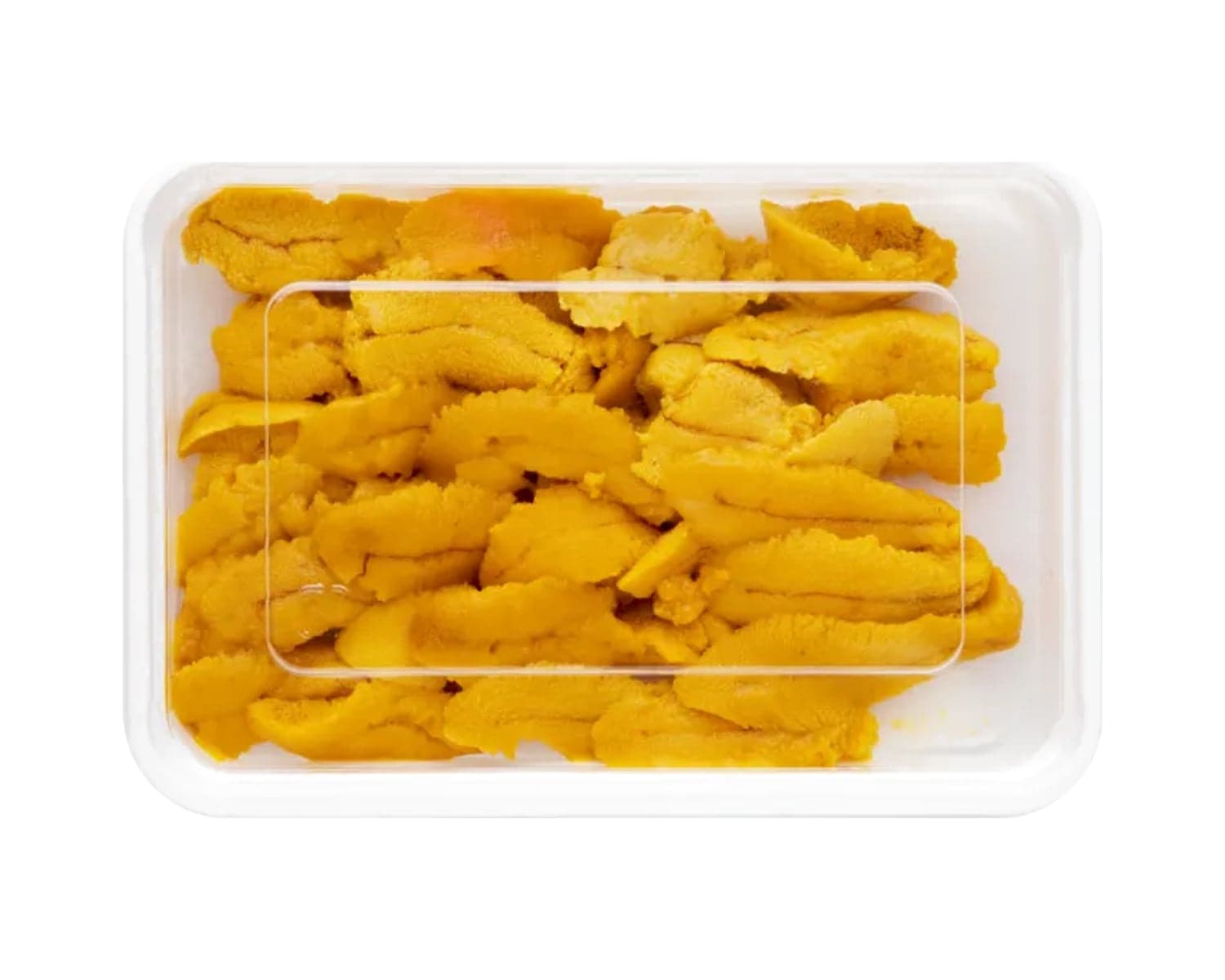
Sea urchins are spiny echinoderms that graze kelp and other seaweed on rocky coasts, and the delicacy sold as uni is their gonads: five tongue-shaped lobes inside the shell, eaten from males and females alike. Nearly a thousand species exist, yet only a small number support fisheries, and eating quality swings with species, diet and season. Our sea urchin roe (uni) page lists the origins, grades and formats we currently ship.
This profile covers the animals and their names, the main producing regions and their seasons, the ways uni is processed and packed, and how kitchens use it from Hokkaido to Marseille. Tray-level grading and the matching of grade to dish are handled on the product page and in our restaurant and retail sourcing guide, so they appear here only in outline.
Key takeaways
- Uni is the gonad of the sea urchin, taken from both sexes; “roe” is a trade convention, not a description.
- Species decides color and flavor, and Japanese markets call bafun types aka and murasaki types shiro.
- Seasons differ by species and region, so year-round uni programs rotate between origins.
- Match the form to the service: tray or brine-packed uni for raw dishes, frozen or pasteurized for cooked ones, with any alum declared.
What a sea urchin is, and why uni is not really roe
Sea urchins make up the class Echinoidea, with roughly 950 living species, and share the echinoderm group with starfish and sea cucumbers. The body sits inside a rigid, rounded shell called the test, built of fused plates and covered in movable spines, with tube feet for gripping and a five-toothed jaw on the underside for scraping food. Most species are grazers that feed mainly on algae, although they will also eat sponges, mussels and other small animals.
Inside the test lie five gonads, which hold the animal’s energy reserves as well as producing eggs or sperm. They swell as the urchin feeds and builds toward spawning and shrink once it has spawned, so the same animal can be full and sweet in one month and nearly empty a few weeks later. “Sea urchin roe” is therefore a trade convention: buyers receive ovaries and testes alike, and on a tray the two are usually hard to tell apart. Timing matters for flavor too: Japanese researchers traced a bitter taste in the ovaries of bafun uni (Hemicentrotus pulcherrimus) to a compound that builds up as they ripen toward spawning.
Urchins also shape their habitat. Where predators are scarce, they can strip kelp forests down to bare rock, leaving “urchin barrens” in places as far apart as Japan, Chile, Australia and California. Animals on barren ground are often too thin in gonad to be worth harvesting, and Japanese researchers have tried fattening them on cabbage and discarded vegetables. Green sea urchins have grazed large stretches of the Norwegian coast down to barrens, and in California the loss of kelp has hit the abalone that share it, as our abalone profile explains.
Edible sea urchin species and their market names
Uni is sold under one word across many species, and their color, size and flavor differ. The table lists the urchins that dominate trade and the names buyers will see.
| Market name | Scientific name | Where it lives | Trade notes |
|---|---|---|---|
| Ezo bafun uni | Strongylocentrotus intermedius | Hokkaido and northern Japan, Korea, the Russian Far East | Highly valued in Japan; deep orange, sold as aka uni |
| Kita murasaki uni | Mesocentrotus nudus | Northern Japan, Korea, northern China | Pale yellow, sold as shiro uni |
| Bafun uni | Hemicentrotus pulcherrimus | Japan from Tohoku to Kyushu, China, southern Korea | Small urchin; orange gonads; source of salted Echizen uni |
| Murasaki uni | Heliocidaris crassispina | Central and southern Japan, southeastern China, Taiwan | Pale gonads, sold as shiro uni |
| Red sea urchin | Mesocentrotus franciscanus | Alaska to Baja California | Large, long-lived; dive-caught on the Pacific coast |
| Green sea urchin | Strongylocentrotus droebachiensis | Cold northern waters of the Atlantic and Pacific | Small; fished in Maine, Atlantic Canada, British Columbia and Norway |
| Chilean sea urchin, erizo | Loxechinus albus | Pacific coast of South America south to Cape Horn, and the Falkland Islands | Fished along the Chilean coast since the 1960s |
| Ricci, oursin | Paracentrotus lividus | Mediterranean and nearby Atlantic coasts | Eaten raw in Italy and France, and in Italian pasta dishes |
| Kina | Evechinus chloroticus | New Zealand | Mainly eaten raw within New Zealand |
Two naming traps are worth knowing. Japanese markets sort uni into aka (red, meaning deep orange) and shiro (white, meaning pale yellow): bafun and ezo bafun uni count as aka, murasaki and kita murasaki uni as shiro, so the terms describe the species group as much as the grade. And names change: the red sea urchin and kita murasaki uni have been moved from Strongylocentrotus to the genus Mesocentrotus, so older documents may still call them Strongylocentrotus franciscanus and S. nudus.
Where sea urchins are harvested, and when
Almost all uni comes from wild urchins collected by divers or, in some fisheries, by drag or trawl. Each region sets its own seasons, size limits and licensing, and gonad quality peaks at different times of year, which is why importers who want year-round supply move between origins.
- Japan: Hokkaido is the main domestic source, and its seasons differ from coast to coast: Shakotan on the Sea of Japan side is known for summer uni, while grounds in eastern Hokkaido such as Nemuro are fished in winter. Japan also imports uni from several countries, Russia among them.
- Pacific North America: divers take red sea urchin from British Columbia south to Baja California for uni processing.
- Green sea urchin fisheries: in Maine, divers and draggers land green sea urchins mainly between September and March, under a zoned system that limits fishing days; regulated fisheries also operate in Atlantic Canada and British Columbia, and the fishery’s growth in Maine from the late 1980s was driven by Japanese demand.
- Chile and Peru: Loxechinus albus supports South America’s main uni fishery, and local management rules shape how much reaches export.
- Europe: Mediterranean Paracentrotus lividus is gathered for local and regional markets, and Norway also lands green sea urchins.
Farming plays a minor role. Japan releases hatchery-reared juveniles onto its fishing grounds, a university hatchery in Maine has run green sea urchin culture trials since the mid-2000s, and projects that fatten urchins taken from barren ground are still developing. For most buyers, uni remains a wild, seasonal product.
How uni is packed: trays, brine, frozen and salted
The gonads are delicate and begin to soften within days of extraction, so processing is largely about holding their shape and flavor long enough to reach a kitchen. The table summarizes the forms found in the trade; our product page states which of them we supply.
| Form | How it is prepared | Keeping quality | Best suited to |
|---|---|---|---|
| Live in the shell | Whole urchins shipped chilled | Days | Opening to order, raw bars, grilling in the shell |
| Tray uni (ita uni) | Lobes laid in rows on small trays, often after a light alum wash | A few days chilled | Nigiri, gunkan-maki, sashimi |
| Brine-packed uni (ensui uni) | Lobes held in salt water instead of an alum treatment | A few days chilled | Raw service where a clean, unaltered flavor matters |
| Frozen uni | Lobes frozen in trays or cups | Months frozen | Pasta, sauces, rolls, production kitchens |
| Pasteurized or steamed uni | Heated in sealed packs or steamed | Longer than fresh, chilled as labeled | Sauces, gratins, cooked dishes |
| Salted uni and uni paste | Cured with salt, or blended with salt or sake | Long | Seasoning, rice dishes, dressings |
Alum is the point buyers ask about most. Japanese packers use it to firm the lobes so they hold their shape on the tray, but Japanese sources also note that it can dull the flavor, and brine-packed uni is the usual alternative for buyers who want it untreated. Labeling rules in many markets require additives such as alum to be declared, so ask for the treatment in writing. Uni is not caviar and is not CITES-listed; our caviar and fish roe guide sets out how the two are treated differently.
How sea urchin is eaten around the world
Good uni tastes sweet and briny at once, with a rich, custard-like texture that melts on the tongue. Japan consumes it mainly raw, as sashimi, as nigiri or gunkan-maki sushi and piled over rice as uni-don, and also serves it grilled or steamed. Salt-cured uni, of which Echizen uni from Fukui is the best-known example, was historically counted among Japan’s three great delicacies, and uni paste blended with salt or sake is used as a seasoning.
Elsewhere the dishes are simpler. In Italy, ricci di mare are eaten raw with lemon or stirred into pasta sauces, and French cooks also use oursin to flavor omelettes and sauces. In and around Marseille, urchin festivals called oursinades celebrate the local oursin. Chileans serve erizos raw with lemon, onion and olive oil, and New Zealanders traditionally eat kina raw. On modern menus uni also turns up in butter, sauces and seafood platters, often beside caviar and other premium roe.
This guide is general trade information, not legal or regulatory advice. Requirements differ by market and change over time; confirm current rules with your customs broker or competent authority before ordering.