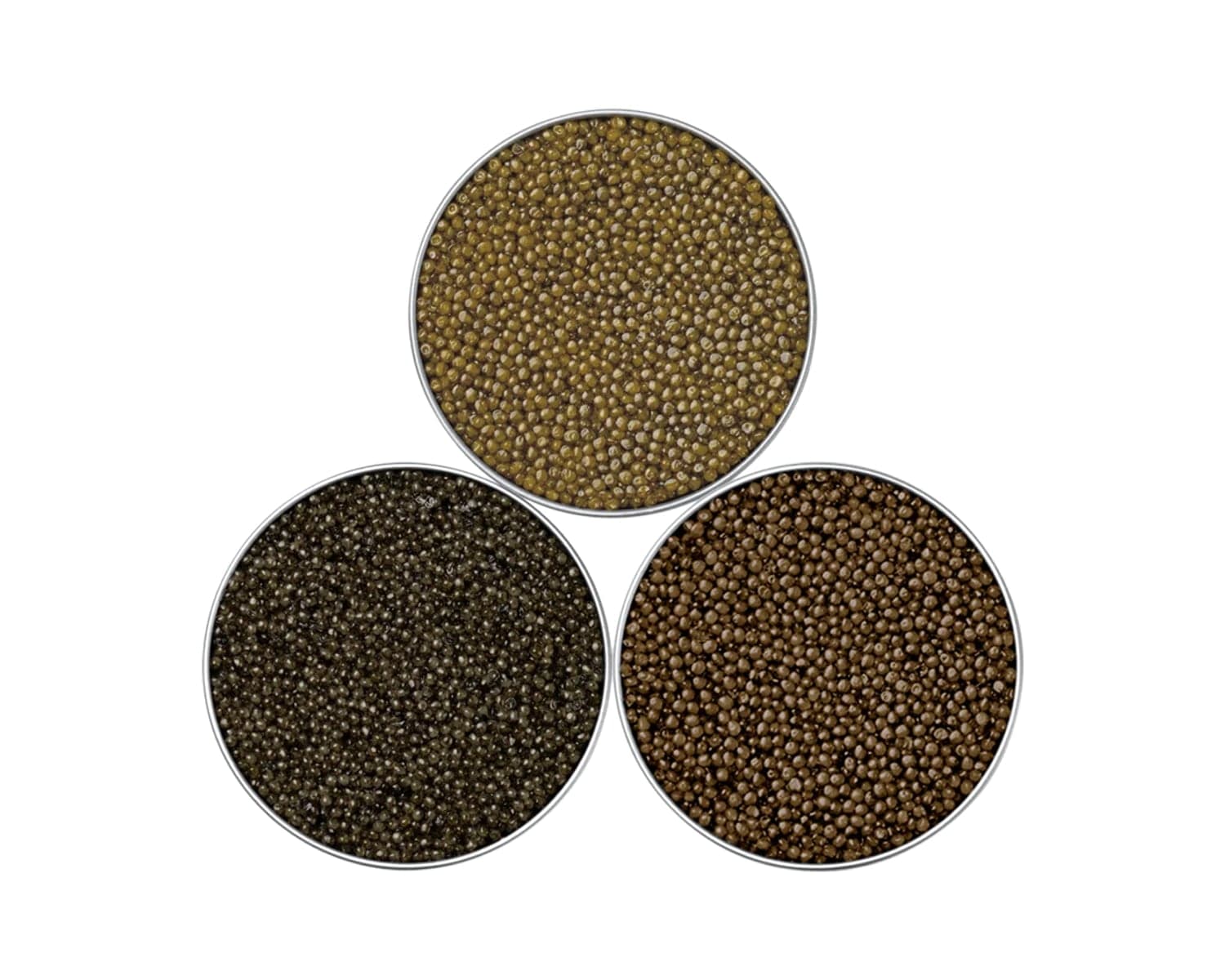
Sturgeon are large, armored, bottom-feeding fish from one of the oldest surviving lineages of ray-finned fish, and for most buyers they matter for one reason: their lightly salted roe is caviar. Wild stocks have collapsed almost everywhere, so the sturgeon behind today’s legal caviar trade are mainly farmed, and those farms produce far more sturgeon meat by weight than roe. The farmed species and hybrids we offer as caviar are listed on our premium roe and caviar page.
Our caviar and fish roe guide already covers CITES permits and tin labels, the malossol style and caviar grading. This profile stays with the fish: how sturgeon are built and how they live, how the main species differ, how farms raise them from fingerling to roe harvest, how the meat is used and which legal points apply to sturgeon products beyond the tin.
Key takeaways
- Sturgeon are slow-maturing, long-lived fish whose wild stocks are among the most threatened of any animal group, so legal caviar and meat now come mainly from farms.
- Siberian sturgeon is among the most widely farmed species, while Chinese farms rely heavily on Amur sturgeon and its hybrids with kaluga and Siberian sturgeon.
- Farms sex fish by ultrasound or biopsy, sell the males for meat and keep females for around seven years or longer, depending on species, before the caviar harvest.
- CITES covers sturgeon meat and other parts as well as caviar, and some countries add restrictions on particular species such as beluga.
What sturgeon are
Sturgeon and their close relatives the paddlefishes make up the order Acipenseriformes. True sturgeon form the family Acipenseridae, and the only surviving paddlefish is the American paddlefish (Polyodon spathula), since the Chinese paddlefish was declared extinct in 2022.
A sturgeon is easy to recognize. Five rows of bony plates, called scutes, run along the body: one down the back, one along each side and one along each lower flank. The snout is long, four sensory barbels hang in front of a toothless mouth on the underside of the head, and the mouth extends downward to suck food off the bottom. The upper lobe of the tail is longer than the lower, and the skeleton is made largely of cartilage.
Most species are anadromous, living in the sea or in large lakes and running up rivers to spawn, while a few, such as the sterlet and the Siberian sturgeon, live mainly or wholly in fresh water. They locate food with the taste and touch receptors on their barbels and feed on bottom invertebrates and, in the larger species, on fish.
Size and age can be extreme. The beluga is the largest: the biggest accepted record, a female taken in the Volga estuary in 1827, weighed about 1,571 kg and measured 7.2 m, and ages beyond 100 years have been reported. Wild females of many species need one to two decades to mature, which makes stocks very slow to recover from overfishing. The 2022 IUCN reassessment found all 26 surviving sturgeon and paddlefish species at risk of extinction, about two-thirds of them critically endangered, with poaching for caviar and meat, dams and habitat loss among the causes.
Sturgeon species in farming and trade
About two dozen sturgeon species survive, but a short list supplies nearly all farmed caviar and meat. The caviar guide describes the grain and color each species gives; the table below covers where each comes from and how it fits on a farm.
| Species | Native range | On the farm |
|---|---|---|
| Siberian sturgeon, Acipenser baerii | Siberian rivers from the Ob to the Kolyma, and Lake Baikal | Among the most widely farmed species; tolerates water from about 1 °C to 25 °C, and farmed females mature at around seven years |
| Russian sturgeon, A. gueldenstaedtii | Caspian, Black Sea and Sea of Azov basins | Farmed in Europe, Asia and elsewhere; the species behind oscietra caviar |
| White sturgeon, A. transmontanus | Pacific coast rivers of North America | Farmed in northern California and British Columbia, among other places; often described as North America’s largest freshwater fish |
| Amur sturgeon, A. schrenckii | Amur River basin | A mainstay of Chinese farms, raised pure or crossed with kaluga or Siberian sturgeon |
| Kaluga, Huso dauricus | Amur River basin | Prized for its size; farmed in China both pure and, widely, as a hybrid with Amur sturgeon |
| Beluga, Huso huso | Caspian and Black Sea basins; formerly also the Adriatic | The largest sturgeon and critically endangered; farmed in some countries but slow to mature and heavily restricted in trade |
| Sterlet, A. ruthenus | Rivers draining to the Black, Azov and Caspian Seas, and Siberian rivers from the Ob east to the Yenisei | A small river species, commonly about 40 cm long; farmed widely in Europe and Russia |
| Adriatic sturgeon, A. naccarii | Adriatic Sea and its large rivers, including the Po | Critically endangered in the wild; farmed on a small scale, for example in Spain, and bred in captivity in Italy for restocking |
Taxonomy is shifting under the trade, and reference sources do not yet agree. Genetic studies show that the traditional genera do not match the family tree, and they have prompted competing fixes. Some databases, WoRMS among them, now list the beluga as Acipenser huso. A 2025 revision went the other way, keeping only three Atlantic species in Acipenser, moving most others, including the Siberian and Russian sturgeons and the sterlet, into Huso, and placing the Pacific-basin species, among them the white, Amur and kaluga sturgeons, in a revived genus, Sinosturio. Other ichthyologists have disputed the genus names in that revision, so more change is likely. CITES documents and caviar labels still use the established names shown in the table. Where a certificate and a reference source disagree, check for a synonym before assuming a different fish.
Hybrids are common because a cross can combine the growth or hardiness of one parent with the roe of the other. In Chinese production, crosses of kaluga with Amur sturgeon and of Siberian with Amur sturgeon rank alongside the pure species.
How sturgeon farming works
Sturgeon farming grew out of Soviet hatchery and stocking work. Farming of Siberian sturgeon began in the former USSR in the 1970s, and in the same decade the first fish reached France under a Franco-Soviet research program. Fish are now raised in raceways, circular tanks, ponds, net cages in lakes and reservoirs, and recirculating systems. China produces most of the world’s farmed sturgeon, with large operations such as those on Qiandao Lake in Zhejiang, and Russia, Iran, Italy, France, Poland, Germany, the United States and Uruguay are among the many other producers.
Young sturgeon show no outward difference between the sexes, so farms sort them once the gonads can be read, either by ultrasound or by examining the gonad through a small surgical opening. In Siberian sturgeon this is normally done at about three years, and the males, which produce no caviar, are then sold for meat. Females stay until their roe is ripe, at around seven years in Siberian sturgeon and longer in large species such as white sturgeon and beluga.
As harvest approaches, farmers track egg development, often by ultrasound, to choose the moment. Most caviar is still produced by stunning the female and removing the ovaries, after which the carcass goes to the meat trade. Some farms instead take ripe eggs through a small incision or by massage, so the female can produce again. In Siberian sturgeon the roe typically amounts to about 8 to 14 percent of the female’s live weight.
Sturgeon meat and its uses
Farms sell sturgeon meat live, whole, as fillets and steaks, or smoked, depending on the market; in China, fish are also sold live at one to two kilograms. The flesh is firm, dense and pale with a mild flavor, and because the skeleton is largely cartilage it portions cleanly into boneless fillets and steaks that hold together on a grill. The bony scutes and thick skin are removed in processing.
- Smoked sturgeon: hot- or cold-smoked sides, firm enough to slice thinly, are a long-standing delicacy in Russia and Eastern Europe and well beyond.
- Balyk: the salted and dried, or smoked, back of a large fish, with sturgeon balyk traditionally ranked the finest of all.
- Grilling and braising: steaks and cubes suit skewers, grills and stews because the flesh does not flake apart.
- Vyaziga: the dried notochord, the cord that runs along the spine, once a prized filling for the Russian fish pie kulebyaka and rarely seen today.
- Isinglass: sturgeon swim bladders were the original source of this fining agent for clearing beer and wine, although commercial isinglass now comes from tropical fish.
Smoked and cured sturgeon is a lightly preserved, ready-to-eat product, so keep it chilled within the temperature and shelf-life limits on the label and follow your market’s rules for ready-to-eat fish. Distributors building a cured-roe range often add a second species alongside caviar; our gray mullet species guide covers the fish behind bottarga.
Legal notes for sturgeon products
All sturgeon and paddlefish species have been listed under CITES since 1998. Two, the shortnose sturgeon (Acipenser brevirostrum) and the European sea sturgeon (A. sturio), are in Appendix I, the strictest listing, under which commercial trade in wild specimens is generally prohibited; the rest are in Appendix II. The listing covers the fish and its parts and products, not only caviar, so farmed sturgeon meat moving between countries also travels on CITES export documents.
Some countries go further than CITES. The United States, for example, lists the beluga as threatened under its Endangered Species Act and in 2005 suspended imports of beluga caviar and meat from the Caspian and Black Sea basin countries. Confirm the status of each species and hybrid with your CITES management authority and customs broker before ordering.
Species substitution and false claims of origin are documented problems in sturgeon products: a cheaper species sold as a dearer one, a hybrid described as a pure species, or wild fish passed off as farmed. The CITES label code names the species, and laboratories can identify sturgeon species, and many hybrids, from DNA. Roe from the American paddlefish and from the shovelnose sturgeon, sold as hackleback, is a legitimate product where its harvest is permitted, but it must be labeled as what it is.
This guide is general trade information, not legal or regulatory advice. Requirements differ by market and change over time; confirm current rules with your customs broker or competent authority before ordering.