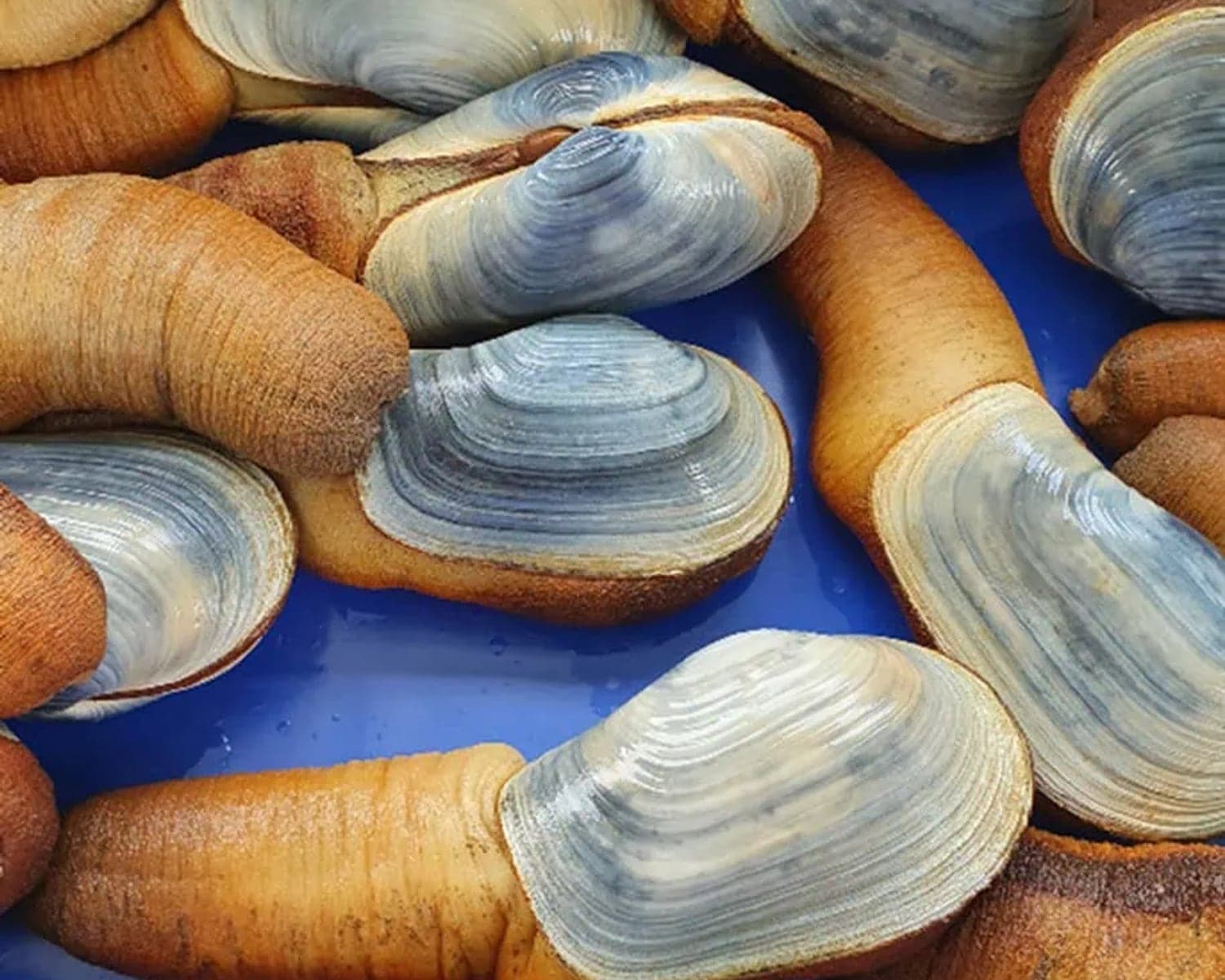
Geoduck, pronounced “gooey-duck”, is a very large burrowing clam from the Pacific coast of North America, prized for its long, fleshy siphon. Commercial supply comes from dive fisheries in Washington State, British Columbia and Alaska and from farms in Washington and British Columbia, and most of it ends up in Chinese, Japanese and Korean cooking. Our geoduck page sets out the live and frozen formats, grades and origins we source to order.
This profile covers the animal and its biology, its names, relatives and look-alikes, where and how it is harvested, and how the siphon and body are prepared in different cuisines. Biotoxin records and frozen handling, which geoduck shares with other bivalves, are covered in our frozen shellfish buying guide.
Key takeaways
- Geoduck is Panopea generosa, a giant Pacific burrowing clam once widely misnamed Panopea abrupta.
- Supply comes from rationed dive fisheries in Washington, British Columbia and Alaska, and from farms in Washington and British Columbia.
- In Japan, mirugai properly means Tresus keenae; geoduck is sold as shiro-miru, so contract on the scientific name.
- The siphon is the prized part and biotoxins collect mainly in the viscera, which are discarded.
What a geoduck is
The Pacific geoduck, Panopea generosa, is the world’s largest burrowing clam. Its thin, white, gaping shell is commonly 12 to 20 cm long, but the animal is far larger than the shell can hold: the siphon and mantle cannot be pulled inside. Washington’s fish and wildlife agency puts the average Puget Sound geoduck at roughly 1 kg including the shell, and the largest specimen its biologists have weighed and verified at 3.7 kg.
Geoducks live buried about 60 to 90 cm deep in mud, sand or gravel. Only the tip of the siphon reaches the surface, drawing in water from which the clam filters plankton. They grow fast at first, reaching around 0.7 kg in three to five years and full size at about fifteen, then simply go on living: Washington’s biologists report animals more than 160 years old.
Within Washington, the great majority of geoducks live below the low-tide line, and underwater cameras have recorded them as deep as about 110 m in Puget Sound. A small share live on intertidal beaches, where recreational diggers reach them only on the lowest tides. The species is rarely found on Washington’s Pacific beaches and is scarce west of Clallam Bay in the Strait of Juan de Fuca, so the state’s big beds lie in sheltered inland water.
The name comes from gʷídəq in Lushootseed, the Indigenous language of the Puget Sound region, though what the word originally meant is uncertain. The scientific name has its own history. For decades, until a 2010 study corrected it, the living clam was widely called Panopea abrupta, a name that belongs to a fossil clam from Miocene rocks in Oregon, and some older documents still use it.
Geoduck names, relatives and look-alikes
In Chinese the clam is 象拔蚌 (xiàngbábàng), literally “elephant-trunk clam”, after the shape of the siphon, and that is the name on most menus and import documents in Asia. Japanese usage is more tangled. The traditional mirugai, also called mirukui or hon-miru, is a different clam, Tresus keenae, of the family Mactridae. Imported geoduck and the native Japanese Panopea japonica are sold as shiro-miru (white miru). English menus that translate mirugai as “giant clam” add to the confusion, since giant clams proper are unrelated tropical reef clams of the genus Tridacna.
| Species | Common name | Where it is found | Trade notes |
|---|---|---|---|
| Panopea generosa | Pacific geoduck | Alaska to Baja California; fished in Washington, British Columbia and southeast Alaska | The main commercial geoduck, live and frozen |
| Panopea globosa | Cortes geoduck | Mexico | Offered as a distinct species and named as such |
| Panopea zelandica | Deepwater clam | New Zealand | Small fishery since the late 1980s, now under quota |
| Panopea japonica | Japanese geoduck, namigai | Japan | Sold in Japan as shiro-miru |
| Tresus keenae | Mirugai, mirukui, hon-miru | Japan | The original mirugai, from a different family |
Once siphons are skinned and sliced, these clams are hard to separate by eye, and price differences between them are wide. The scientific name and harvest area on the documents are the only dependable check, so write both into the contract. Our clam species guide explains how geoduck fits among the wider clam families, and the surf clam guide covers another large clam used in sushi.
Where geoduck comes from: dive fisheries and farms
Washington’s legislature established the state’s commercial geoduck fishery in 1970, and wild geoduck is harvested by divers. In Washington, the Department of Natural Resources manages the commercial harvest and the Department of Fish and Wildlife handles the biology and enforcement, with the treaty tribes taking part in the fishery as co-managers since 1995. The state’s own figures show why harvest is rationed: within Washington, abundant populations occur only in Puget Sound and Hood Canal, and a harvested bed takes an average of about 55 years to recover.
British Columbia runs a large dive fishery along its coast, and in Alaska geoduck is fished in the southeast, where the densest beds lie around the island groups west of Craig. Farming adds a second stream of supply in Washington and British Columbia, where hatchery seed is planted in intertidal and subtidal beds and harvested years later. Farmed geoduck needs clean, classified water, and in Washington a grower needs both an aquatic farm registration from the fish and wildlife agency and a shellfish license from the health department to sell it. Related species from Mexico and New Zealand reach the market in smaller volumes.
Because wild tracts open in rotation and farms harvest to plan, geoduck is available through much of the year rather than in one short season. Every harvest area is monitored for paralytic shellfish toxins. Alaska’s fish and game department notes that these toxins collect mainly in the viscera, while the siphon and mantle are the parts normally eaten, and that processed clams with the viscera removed sell for much less than live, whole ones.
How geoduck is prepared and cooked
A geoduck has three parts that matter to a cook. The siphon, or neck, is the prize: sweet, clean and crunchy when raw. It is covered in a tough outer skin that is stripped off before slicing. The mantle, the softer body meat around the organs, is eaten as well. The viscera are discarded.
- Chinese cooking: thin slices of siphon go briefly into hot pot, and many restaurants keep live geoduck in tanks for diners to choose from.
- Japanese cooking: the siphon is served as sashimi or sushi with soy sauce and wasabi, prized for its crunch.
- Korean cooking: raw siphon is eaten with a chili-based dipping sauce.
Most recipes serve the siphon raw or cook it only for moments, which keeps its sweetness and crunch. For raw service, the lot must come from an approved harvest area and be handled as your market’s rules for raw bivalves require. Kitchens that cannot take live clams, or that need even slices in volume, often use frozen siphon meat instead. Live geoduck earns its price where the clam is shown to the guest or sliced for sashimi within hours; frozen siphon fits hot pot, set menus and sushi production, where even slices and steady cost count for more than the last degree of crunch.
Buying geoduck: live, frozen and the paperwork
Live geoduck carries the highest price and the strictest conditions. It travels by air, out of water, in cold, damp packing, and many importing countries apply animal-health and bivalve sanitation rules that limit which harvest areas they accept, or suspend areas for a time after a test finding. Grading starts with weight and moves on to siphon color, with pale ivory necks earning the top grades in most Asian markets, as our product page explains in detail.
The forms on offer follow from those constraints:
- Live whole: the top of the market, for tank display and raw service, shipped only where route and import rules allow.
- Frozen whole: individually wrapped clams for markets closed to live bivalves or too far for a live route.
- Skinned siphon meat: frozen necks with the skin already removed, ready for slicing.
- Sliced siphon: frozen, interleaved slices for sushi and hot pot service in volume.
- Processed clams with the viscera removed: a lower-priced form in the wider trade, worth far less than live whole clams.
Signs of a sound live clam are easy to learn: the siphon should be plump and should retract or twitch when touched, the shell should be unbroken, and there should be no sour or ammonia smell. Frozen geoduck, whole or as skinned siphon meat, removes the transit risk and suits markets closed to live bivalves. The same planning logic as our live abalone program applies to live orders: check the route and permits first. Send your arrival airport and intended use to ask for a live geoduck quote, and our abalone profile covers another premium mollusc often bought alongside it.
This guide is general trade information, not legal or regulatory advice. Requirements differ by market and change over time; confirm current rules with your customs broker or competent authority before ordering.