Blue swimming crab is the crab of warm, shallow Indo-Pacific coasts: a fast-growing, paddle-legged swimmer that supports village fisheries from the Philippines to Sri Lanka and is the source of much of the pasteurized crab meat sold in North America and elsewhere. Our blue swimming crab page covers the whole frozen crab and the pasteurized meat grades we supply.
This profile is about the animal. It explains the 2010 revision that turned one species into four, how to recognize the crab and its sexes, the names it carries in its producing countries, where it lives and how it is fished, how it is cooked across Asia and beyond, and the swimming crabs it is most often confused with.
Key takeaways
- Blue swimming crab is a paddle-legged portunid of shallow Indo-Pacific waters; males are blue with pale mottling, females green to brown.
- Since 2010 the former P. pelagicus has been treated as four species, pelagicus, reticulatus, armatus and segnis, divided by region.
- Flower crab, blue swimmer, rajungan, alimasag, pu ma and ghẹ xanh are among its market names, and some of them also attach to other crabs.
- Gazami, the three-spot crab and Atlantic blue crab look similar or share grade names, so the scientific name must travel with the product.
What a blue swimming crab looks like
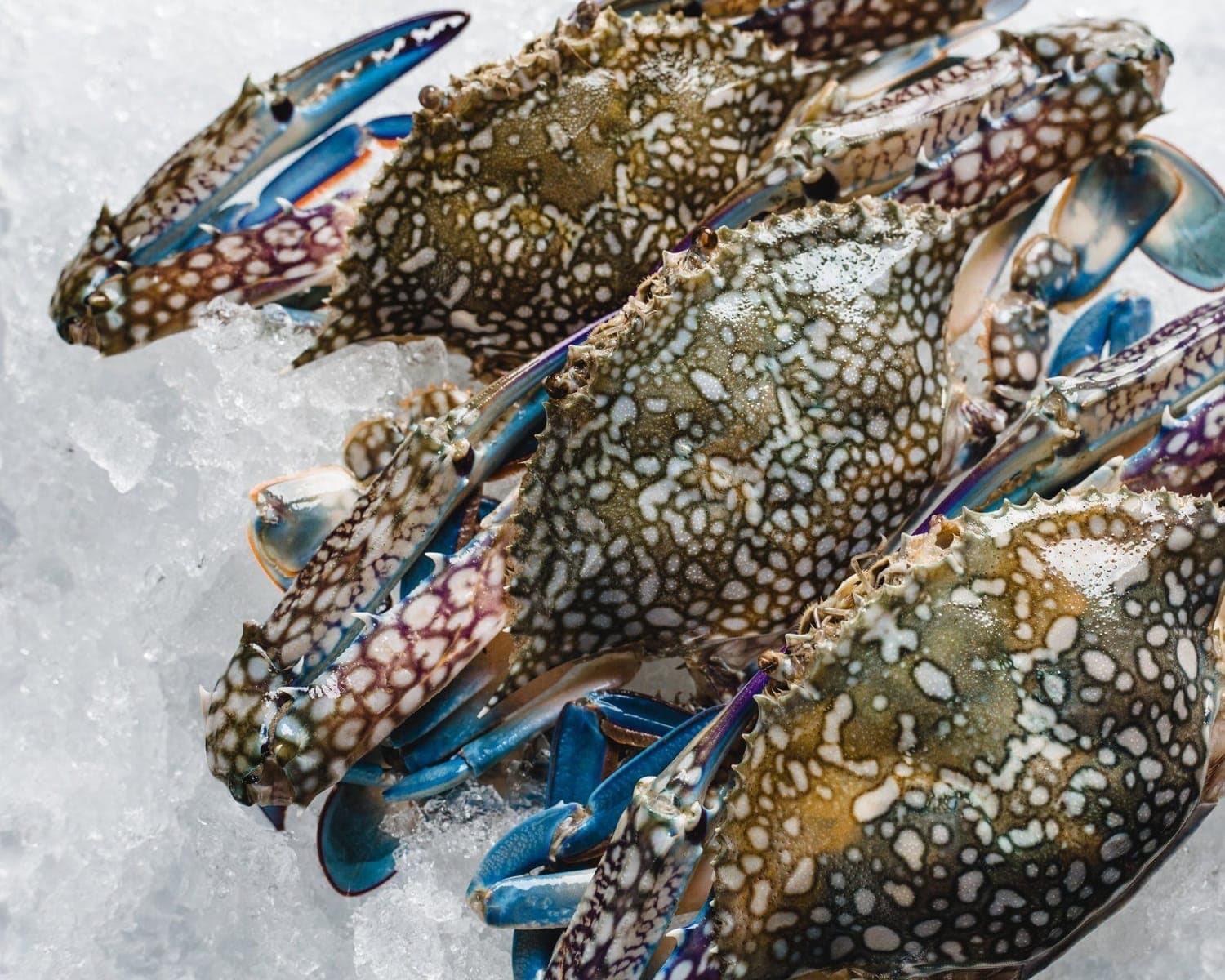
Blue swimming crab belongs to the Portunidae, the swimming crabs, whose last pair of legs is flattened into broad paddles. It swims well, and when disturbed it buries itself in the sand. The carapace is wide and fairly flat, drawn out at each side into a long, sharp spine, and the claws are long and slender, with spines along the arm.
The sexes look strikingly different. Mature males are blue to blue-purple with pale mottling across the shell and legs, and they carry longer claws; females are dull green to olive-brown. Shell width reaches about 20 cm, and the crab grows quickly, maturing at around one year old.
It lives on sandy and muddy bottoms from the shoreline to about 65 m, most often shallower than 40 m, around mangroves, seagrass meadows, algal beds and reefs, and it also enters brackish water. Juveniles keep to the shallow intertidal zone. It is a tropical to subtropical animal, most at home in water of around 26 °C, and an active, carnivorous predator that also scavenges.
One species becomes four: the Portunus pelagicus complex
Until 2010, the blue swimming crabs of the Indian Ocean, Southeast Asia and Australia were usually treated as a single species. A revision by Lai, Ng and Davie, published in the Raffles Bulletin of Zoology in 2010, used molecular and morphological evidence to recognize four:
| Species | Range | Notes for buyers |
|---|---|---|
| Portunus pelagicus | West Pacific from Japan, Korea and China to the Philippines and Indonesia, west to the Strait of Malacca and Thailand; also recorded in Australia’s Northern Territory | The name kept for the East and Southeast Asian crab |
| Portunus reticulatus | Bay of Bengal: the southeastern coast of India, Sri Lanka and Thailand’s Andaman coast | May appear on documents for crab from these coasts |
| Portunus armatus | Most of the Australian coast, and New Caledonia | Sold in Australia as blue swimmer crab |
| Portunus segnis | Western Indian Ocean, from Pakistan and the Persian Gulf to the Red Sea and East Africa; spread into the Mediterranean through the Suez Canal | Now fished off Tunisia, where it has become common |
Older literature, and some trade documents, still use P. pelagicus for all four. A certificate naming a different Portunus species for a crab that looks the same is therefore not necessarily an error; what matters is that the name matches the origin and the packer’s identification.
Blue swimming crab names by country
The crab carries a long list of local names, and several of them also attach to other species. These are the ones a buyer is most likely to meet:
- Flower crab: Singapore and India; in Cantonese, 花蟹, a name also given to other crabs. The formal Chinese name is 远海梭子蟹.
- Blue swimmer or blue swimmer crab: Australia, where most crab is now identified as P. armatus.
- Rajungan: Indonesia.
- Alimasag, also kasag, lambay or masag: the Philippines.
- Pu ma (ปูม้า): Thailand.
- Ghẹ xanh: Vietnam.
- Taiwan-gazami (タイワンガザミ): Japan, where the similar gazami is a different species.
- Étrille bleue: the FAO name in French.
- Blue crab: used loosely in India and elsewhere, which invites confusion with the Atlantic blue crab of the Americas.
Where blue swimming crab comes from and how it is caught
Commercial blue swimming crab is wild-caught, mostly in coastal fisheries worked from small boats that set crab traps and bottom gillnets close to shore. Indonesia, the Philippines, Vietnam, Thailand, Sri Lanka and India are among the main producing countries for crab meat and whole crab.
Elsewhere, Australian fisheries land mainly P. armatus, and the crab of the Persian Gulf and Red Sea is now treated as P. segnis. That species was one of the earliest marine animals to enter the Mediterranean through the Suez Canal, and since its first record off southern Tunisia in 2014 it has become common enough there to support a new fishery.
Management in many areas relies on minimum sizes and protection for egg-bearing females. Queensland, for example, sets an 11.5 cm minimum shell width and bans the taking of females, and Thai coastal communities run crab banks where egg-bearing females are kept until they release their eggs. Measures differ by country and change over time, so the fishing area named on an offer is the starting point for checking which rules apply. Landings also vary with season and weather in each area, which affects whole crab and meat alike.
Market forms and how kitchens use them
Close to the landing site, blue swimming crab is sold live or freshly cooked. For export, it becomes whole frozen crab, cut crab or hand-picked meat that is sealed and pasteurized, each suited to different dishes. With whole crab, weight for size is the quickest guide to quality: a crab that feels heavy for its width is full of meat, while a light one has molted recently.
| Form | What it is | Typical uses |
|---|---|---|
| Live crab | Sold mainly in markets near the landing site | Steaming, curries and stir-fries in producing countries |
| Whole frozen, raw or cooked | Whole crab frozen soon after landing and sold by piece weight | Steamed crab, chili and curry dishes, hot pot, seafood boils |
| Cut crab | Cleaned halves or sections with the legs attached | Curries, stir-fries and soups |
| Jumbo lump and lump meat | Large white body muscles, picked by hand and pasteurized | Crab cakes, crab cocktails, composed salads |
| Backfin and special meat | Smaller white flakes from the body | Dips, soups, fillings and pasta sauces |
| Claw meat | Darker, more strongly flavored meat from the claws | Soups, fried rice and sauces |
- Thailand: pu ma steamed whole or stir-fried.
- The Philippines: alimasag steamed or boiled.
- Chinese kitchens across the region: flower crab steamed whole.
- Sri Lanka and southern India: crab curries.
- North America, Europe and the Middle East: pasteurized meat in crab cakes, salads, dips, pasta and soups, where it is widely used in place of Atlantic blue crab.
Pasteurized meat is a chilled product with a refrigerated shelf life, so it travels in reefers set just above freezing; our reefer and cold-chain guide explains set points and logger records. When a recipe needs a heavier crab with bigger claws, mud crab is the usual alternative.
Crabs that look like blue swimming crab
- Gazami or horse crab (P. trituberculatus): the swimming crab of temperate East Asia, called gazami in Japan and widely known there as watarigani, and the basis of one of the world’s largest crab fisheries, centered on China. It looks very similar; Japanese field guides separate the two by the spines on the claw arm, three in blue swimming crab and four in gazami.
- Three-spot swimming crab (P. sanguinolentus): greenish to olive-brown, marked by three red to chestnut spots on the rear half of the shell.
- Atlantic blue crab (Callinectes sapidus): a different genus from the western Atlantic whose meat is graded under the same names, so the species has to be stated on any Portunus meat.
- Mud crab (Scylla species): another portunid, but heavier, thick-shelled and armed with massive claws; our mud crab species guide profiles it.
Grade names for crab meat travel across species, so the most reliable comparison between packers is a side-by-side test of the same grade. If you are switching origin or species, request a sample of the grade you use before committing to a program, and see our king crab and snow crab buyer’s guide for the receiving checks that apply to frozen crab.
This guide is general trade information, not legal or regulatory advice. Requirements differ by market and change over time; confirm current rules with your customs broker or competent authority before ordering.