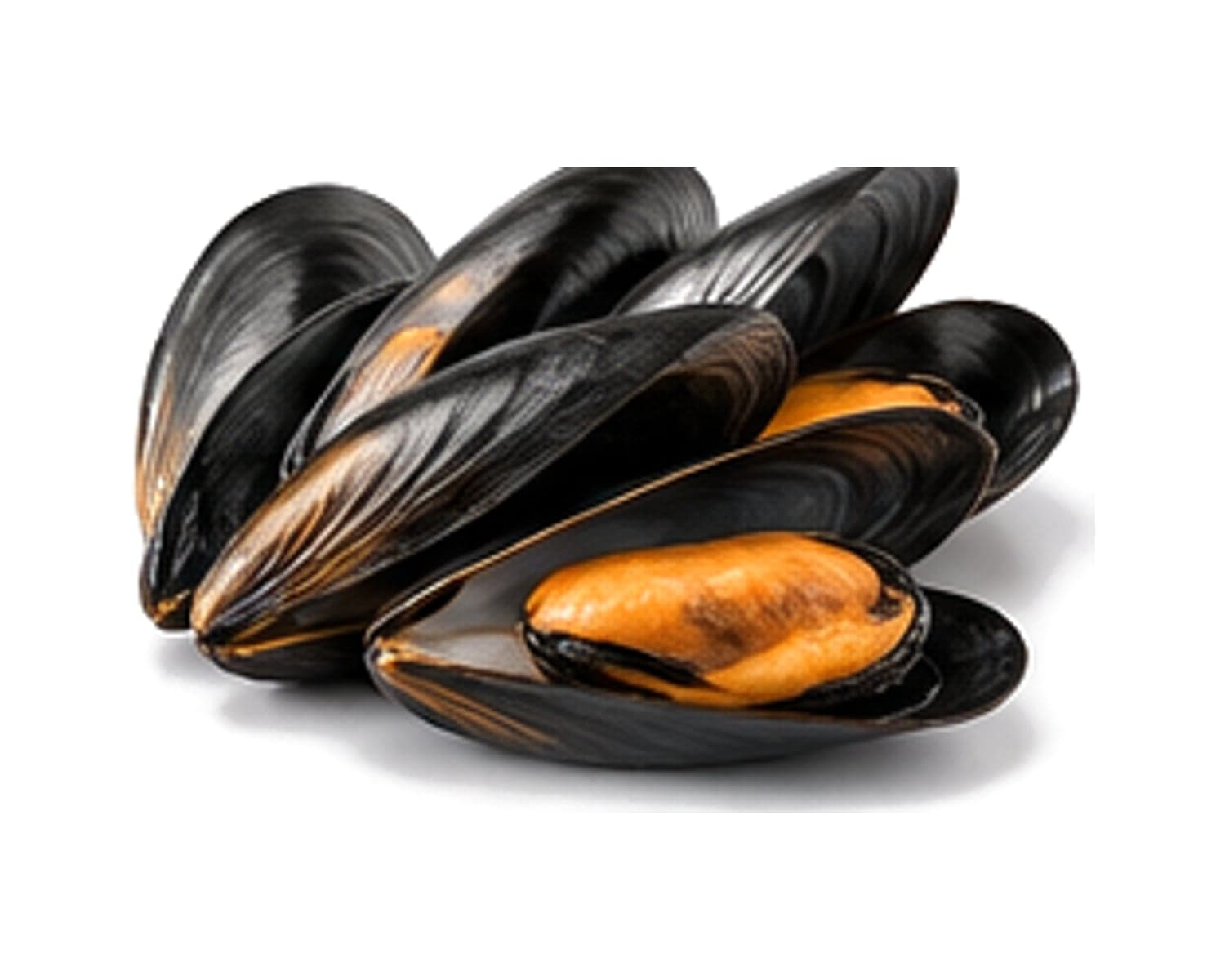
Mussels are bivalves of the family Mytilidae, recognizable by their long, wedge-shaped shells and by the tuft of threads, the byssus or “beard,” with which they anchor themselves to rock, rope or each other. Most commercial mussels are now farmed rather than fished, and two genera supply the bulk of them: Mytilus, the blue mussels of cool and temperate seas, and Perna, the larger green mussels of New Zealand and tropical Asia.
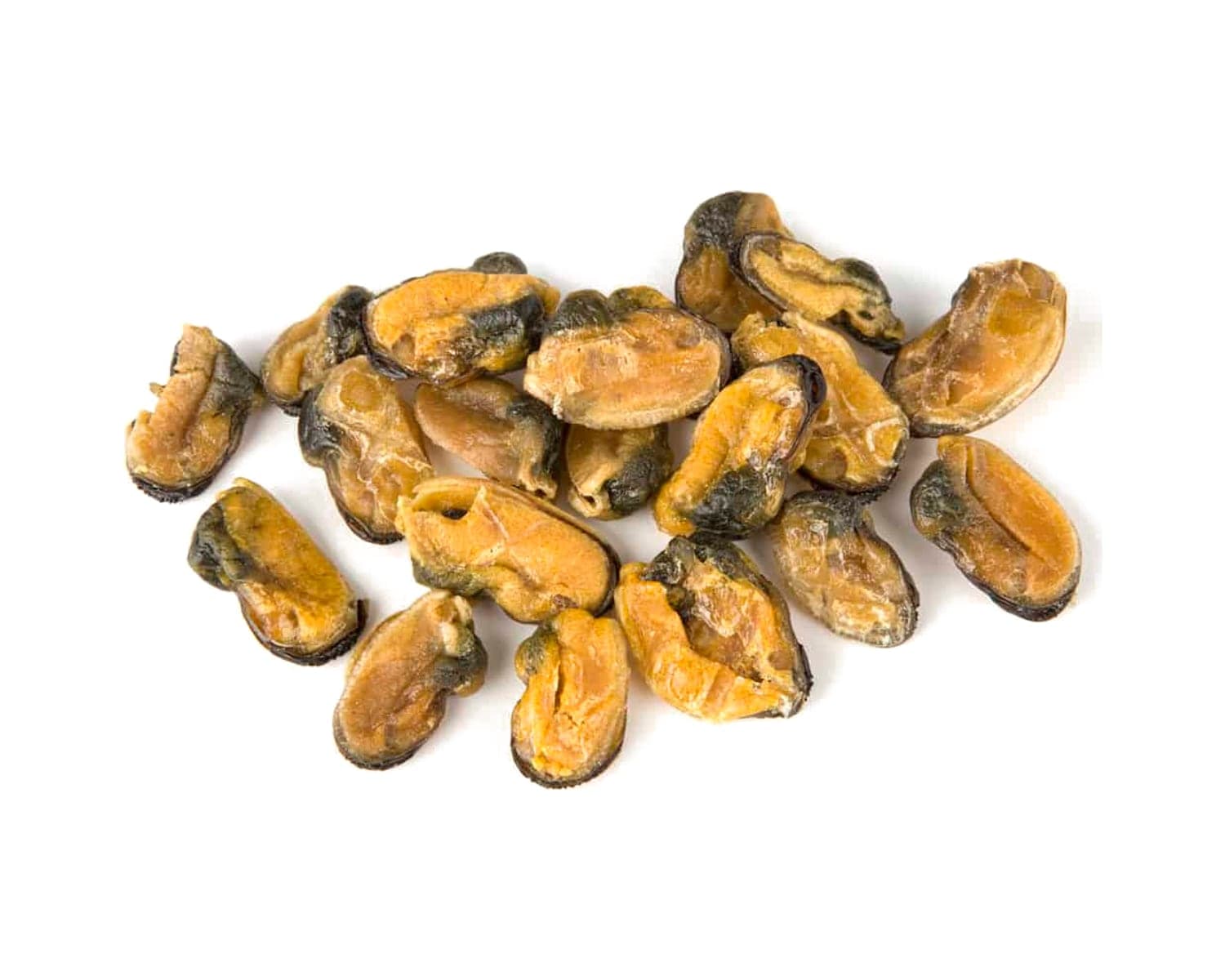
This profile explains how mussels live, how the main species differ, how and where they are grown, and what they are called and cooked as around the world. Blue, Mediterranean, Chilean, green-lipped and Asian green mussels cooked and frozen whole, on the half-shell or as meat are listed on our frozen mussels page, and dried mussel meat for congee and soups on our dried mussels page.
Key takeaways
- Commercial mussels are mostly blue mussels of the genus Mytilus or green mussels of the genus Perna, and most are farmed.
- Orange and cream meats are females and males of the same lot; color is not a quality grade.
- New Zealand green-lipped and Asian green mussels are different species and should be labeled as such.
- Blue mussel species hybridize and look alike, so origin and paperwork, not the shell, identify them.
What makes a mussel
A mussel attaches itself with byssal threads, fine but very strong fibers secreted by a gland at the base of its foot, and it can release and re-anchor them to shift position. Its two valves are closed by two adductor muscles of very different size, a tiny one near the pointed front end and a large one toward the back. Like other bivalves it feeds by filtering plankton; FAO puts the filtering rate of a 5 cm Mediterranean mussel at around 5 liters an hour, which is one reason mussel farms need open, well-flushed water.
Mussels have separate sexes, and their reproductive tissue spreads through the mantle, the flap of tissue lining the shell. That is why meat color varies so much within one lot: in both blue and green-lipped mussels, females are orange, from apricot to pink, and males cream to pale white. Neither color says anything about quality. Spawning, by contrast, does matter, since a mussel that has just released its eggs or sperm is thin and watery, and growers plan harvests around the local spawning cycle.
Mussel species compared
| Species | Common names | Where it grows | Shell and size |
|---|---|---|---|
| Mytilus edulis | Blue mussel, common mussel; moule commune in France | North Atlantic: Europe from the White Sea to France, and North America | Blue-black to purple shell, pearly inside with a purple border |
| Mytilus galloprovincialis | Mediterranean mussel; mejillón in Spain | Galicia and the Mediterranean; farmed in China and South Africa; spread widely by shipping | Like the blue mussel but taller, with a darker mantle edge |
| Mytilus chilensis | Chilean mussel, Chilean blue mussel | Southern Chile, farmed intensively around Chiloé | Blue mussel type; exported mainly frozen |
| Mytilus coruscus | Korean or thick-shelled mussel; igai in Japan; chamdamchi in Korea | Coasts of China, Korea, Japan and the Russian Far East | Larger, thicker, dark shell; the traditional dried mussel of East China |
| Perna canaliculus | New Zealand green-lipped mussel | Endemic to New Zealand; farmed on longlines | Large, to 26 cm; green to yellow-brown shell with a bright green inner lip |
| Perna viridis | Asian green mussel | Indo-Pacific, farmed widely in Southeast Asia | Commonly about 8 cm; bright green shell, darker and browner toward the beak |
The two genera are easy to separate in trade: Mytilus shells are blue-black, purple or brown, while the two commercial Perna species have green shells and are often larger. Within each genus it is harder. The New Zealand mussel grows much larger, and FAO describes a milky white interior edged by a distinctive green lip. The Asian green mussel, commonly about 8 cm, has a sharply tapering beak and an iridescent pale bluish-green interior. Perna perna, native to Africa and South America, closely resembles the New Zealand species, according to FAO, although its usual English name is brown mussel.
Blue mussels: one complex, several species
The blue mussel of northern Europe (Mytilus edulis), the Mediterranean mussel (M. galloprovincialis), the Baltic and North Pacific M. trossulus and the Chilean mussel (M. chilensis) are so alike that biologists treat them as the Mytilus edulis complex. They hybridize where their ranges meet, as they do along the coasts of France and the British Isles, and FAO separates the Mediterranean mussel from the blue mussel only by fine points: downturned beaks, taller valves and a darker blue or purple mantle edge. In practice, origin and paperwork identify the species, not the shell.
The naming of South American blue mussels has shifted over the years. Chilean mussels were long treated as a form of M. edulis, and some authors group the blue mussels of both South American coasts under M. platensis. WoRMS currently lists both M. chilensis and M. platensis as valid species, and genetic studies separate Chilean mussels from the Northern Hemisphere blue mussel. For labeling, use the name your market’s official species list gives.
The Mediterranean mussel deserves a note of its own. Native to the Mediterranean, the Black Sea and Europe’s Atlantic coasts, it has traveled on ship hulls and in ballast water, or been introduced for farming, to Asia, Africa and the Americas. In Japan, where it was first recorded in Kobe harbor in the 1930s, it is murasaki-igai and is sold for Western-style dishes as mūru-gai. In Korea the everyday word honghap covers both this introduced mussel and the native Korean mussel (M. coruscus), which is larger and thicker-shelled. Some Korean sources list the native species as M. unguiculatus, an older name that WoRMS treats as forgotten and does not accept.
Green-lipped and Asian green mussels
The New Zealand green-lipped mussel (Perna canaliculus) is found only in New Zealand and is farmed mainly in the Marlborough Sounds, Coromandel and around Stewart Island. FAO notes that it reaches its usual harvest size of 9 to 10 cm in 18 to 24 months on longlines. Much of the industry’s seed comes from an unusual source: young mussels attached to seaweed that washes up on beaches near Kaitaia, in the far north of the North Island, which is gathered and rushed to farms. Each animal stays male or female for life, with creamy white males and orange to pink females.
The Asian green mussel (Perna viridis) is a smaller, faster-living species of warm Indo-Pacific waters, farmed in Thailand, the Philippines and elsewhere in Southeast Asia. The US Geological Survey reports that it can be sexually mature at two to three months of age and lives about three years. Its vivid shell and low cost make it a regional staple, but it is a different animal from the New Zealand mussel, and the two should not be sold under each other’s names. Outside its native range it has established itself as a fouling species in places such as Trinidad, Venezuela and Florida.
How and where mussels are farmed
Mussel farming begins with seed, which in most regions is still collected from the wild. Growers then use one of four main systems, each suited to a different coast:
- Bouchot culture: rows of wooden poles driven into the intertidal seabed and wound with seed-bearing ropes, a French method that FAO dates back to the 13th century.
- Bottom culture: seed dredged from dense natural beds and relaid on managed subtidal plots, the traditional system of the Netherlands, which supplies much of the mussels eaten as moules-frites in Belgium.
- Raft culture: ropes hung from large floating rafts, introduced in Galicia in 1946, where the Ría de Arousa is the most important growing area.
- Longline culture: ropes hung in loops from floated lines, the standard method in New Zealand and one being adapted to more exposed offshore sites.
Mussels grow quickly: FAO notes that most cultured blue mussels reach market size in less than two years. Because they filter so much water, they are often the first shellfish to register marine biotoxins during algal blooms, and growing areas close until tests clear. Harvest-area records and the formats in which mussels are frozen, whole cooked, half-shell or meat, are summarized in our guide to buying frozen shellfish.
Mussel names and dishes by market
- Belgium, France and the Netherlands: moule and mossel. Moules-frites, a Belgian classic, pairs a pot of mussels with fries; moules marinières are cooked with white wine, shallots, parsley and butter, and some cooks use beer instead of wine.
- Spain and Italy: mejillón in Spanish and cozze in Italian. Mussels are steamed with white wine, onion and herbs and added to rice and seafood dishes; in Spain they are also made into tigres, shells filled with a spiced béchamel of chopped mussel, then breaded and fried.
- Turkey: midye dolma, Mediterranean mussels stuffed with spiced rice and served with lemon as a street snack, and midye tava, mussels battered and fried on skewers.
- Thailand: hoi malaeng phu (หอยแมลงภู่) is the green mussel, used in a crisp fried omelette, hoi thot.
- China: 贻贝 is the formal name, 青口 the Cantonese market name and 淡菜 a common name that the trade applies especially to dried mussel meat; Cantonese cooks stir-fry mussels with garlic and fermented black beans.
- New Zealand: green-lipped mussels steamed, made into fritters or used as the base of a chowder.
For two related profiles, see our oyster species guide and clam species guide; mussels often share a menu, and a mixed reefer, with frozen clams. To line up species, origin and format for your own range, share your mussel requirements with us.
This guide is general trade information, not legal or regulatory advice. Requirements differ by market and change over time; confirm current rules with your customs broker or competent authority before ordering.