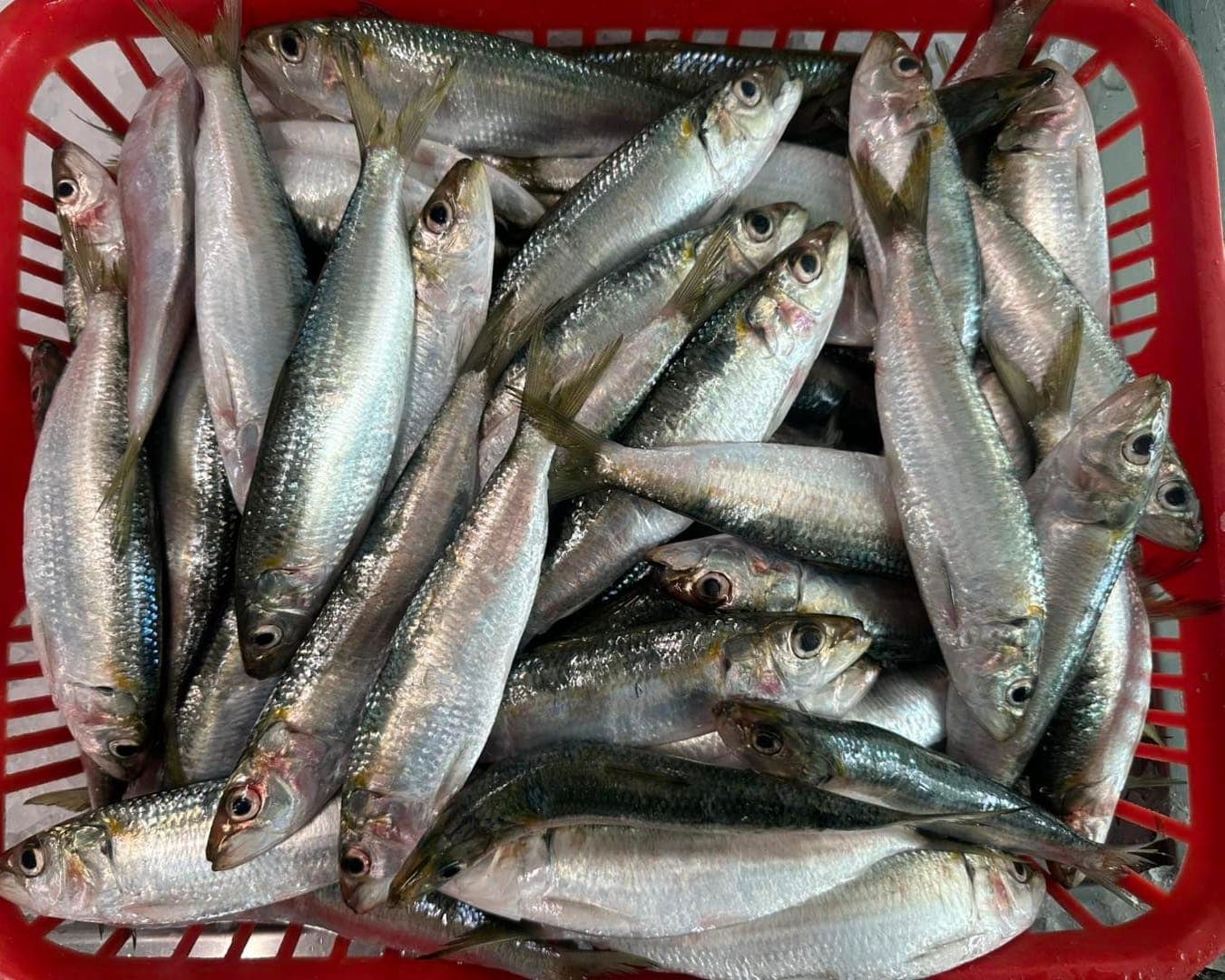
Sardine is a trade name before it is a species. Order sardines in Lisbon, Tokyo, Kerala and Bali and four different fish arrive: the European pilchard, the Japanese sardine, the Indian oil sardine and the Bali sardinella. All are small, oily, silvery fish that swim in huge shoals and are caught mostly with encircling nets such as purse seines, but they belong to different genera, live in different seas and are named differently on labels. Our frozen sardines come mainly from Sardinella fisheries, with the species declared for each lot.
This guide sorts out the naming first, then profiles the three main groups sold as sardines, how to tell them apart, where each is fished, the forms the trade uses and how kitchens around the world cook them. Grading by pieces per kilogram and our lot checks are covered on the product page.
Key takeaways
- Sardine is a trade name for several small clupeoid fish: the European pilchard, Sardinops and many Sardinella species.
- Bony ridges radiating across the gill cover mark Sardina and Sardinops; sardinellas lack them.
- The EU reserves plain “sardines” on cans for Sardina pilchardus, while Codex and many other markets allow qualified sardine names for other species.
- Histamine control depends on fast chilling and freezing, so cold-chain records matter as much as test results.
Why “sardine” covers several different fish
The word sardine reached English from French in the fifteenth century, from Latin and Greek roots that may refer to the island of Sardinia. Pilchard is the other English name for the same European fish, and the two have never been cleanly separated. In Britain, the Sea Fish Industry Authority treats sardines as young pilchards, and a common rule of thumb calls fish under about 15 cm sardines and larger ones pilchards. In South Africa, Sardinops is called pilchard whatever its size; Australians long called it pilchard too, although the national fish names standard now lists it as Australian sardine.
All of these fish are small herring-like fishes of the order Clupeiformes, traditionally grouped in the herring family, Clupeidae. The Codex Alimentarius standard for canned sardines and sardine-type products lists around twenty species that may be packed under a sardine name, including the European pilchard, Sardinops, several sardinellas and even small Atlantic herring and sprat, and the list is amended when producing countries make the case for a species: the Bali sardinella was added in 2024. The EU, by contrast, reserves the plain word sardines on cans for Sardina pilchardus. Peru challenged the EU regulation at the World Trade Organization in the case known as EC – Sardines, the panel and Appellate Body ruled against the European Communities in 2002, and the two sides notified a mutually agreed solution in 2003.
| Group | Main species | Where it is caught | Names in the trade |
|---|---|---|---|
| European pilchard | Sardina pilchardus | North-East Atlantic from the North Sea to Senegal, the Mediterranean and the Black Sea | Sardine, pilchard; sardinha (Portugal), sardina (Spain) |
| Sardinops | Sardinops sagax, including populations once named as separate species | Japan and the North-West Pacific, California, Peru and Chile, South Africa, southern Australia | Ma-iwashi (Japan), Pacific or California sardine, South American and Southern African pilchard, Australian sardine |
| Sardinellas | Sardinella aurita, S. maderensis, S. longiceps, S. lemuru, S. gibbosa, S. fimbriata and others | Warm waters: West Africa, the Mediterranean, the western Atlantic, the Indian Ocean and South-East Asia | Round sardinella, Indian oil sardine (mathi in Kerala), Bali sardinella |
| Other sardine-type fish | Small Clupea harengus, Sprattus sprattus | North Atlantic and Baltic | Sild (small herring), brisling (sprat) |
European pilchard, the original sardine
Sardina pilchardus is the only species in its genus and the fish that European law has in mind when it says sardine. It ranges from the North Sea, and rarely Iceland, south along the Atlantic coast of Europe and North Africa to Senegal, and through the Mediterranean into the Black Sea. Adults commonly reach about 20 cm and rarely exceed 27 cm. By day the shoals hold at roughly 25 to 55 meters, rising toward the surface at night.
The quickest identification mark is on the gill cover: three to five distinct bony ridges radiate downward across its lower part. The last two rays of the anal fin are also enlarged. The back is blue-green and the sides silver. Portugal, Spain and Morocco’s Atlantic coast support the best-known fisheries. The June saints’ festivals of Lisbon and Porto are famous for sardines grilled whole over charcoal, and Portuguese cooks prize the fatter fish of summer and early autumn.
Sardinops: sardines of the Pacific and southern oceans
Sardinops sardines live in the cool, plankton-rich currents of the Pacific and the southern hemisphere: off Japan and Korea, in the California Current, off Peru and Chile, off southern Africa and along southern Australia. Each region’s population was once named as a separate species, among them S. melanostictus in Japan, S. caeruleus off California and S. ocellatus off South Africa, and these names still appear in older documents. Current taxonomic databases such as WoRMS treat them as a single species, Sardinops sagax.
Sardinops grows larger than the European pilchard, to nearly 40 cm, and is easy to recognize by one to three rows of dark spots running along each flank, together with the same radiating ridges on the gill cover. Its populations are famous for boom-and-bust swings over decades as ocean conditions shift. Off the US West Coast, for instance, the directed fishery for Pacific sardine was closed in 2015, when the estimated stock fell below the threshold at which directed fishing stops, and NOAA Fisheries reports that it has not reopened. Much of the catch has historically gone to fishmeal and bait, alongside canning and the fresh trade.
Japan has a particularly rich kitchen tradition for this fish, which it calls ma-iwashi: salt-grilled whole as shioyaki, pounded into tsumire fish balls for soups and hot pots, served as sashimi when very fresh, or dried as mezashi, small fish threaded through the eyes onto a skewer of straw or bamboo.
Sardinella, the tropical sardines
Sardinella is a large genus of warm-water species and makes up most of the sardine catch in the tropics. Sardinellas lack the radiating gill-cover ridges of Sardina and Sardinops, and several species show a faint golden spot behind the gill opening and a black spot at the rear edge of the gill cover. Telling one sardinella from another can depend on counting pelvic fin rays and gill rakers, so species identification is normally a job for the packer’s documents rather than the buyer’s eye.
- Round sardinella (S. aurita): a fish of up to about 40 cm with a faint golden line along the flank. It is caught in the Mediterranean, along West Africa from Gibraltar to South Africa, and in the western Atlantic from New England to Argentina, and it is a mainstay of West African fisheries.
- Madeiran sardinella (S. maderensis): a West African species caught and traded alongside round sardinella.
- Indian oil sardine (S. longiceps): an Indian Ocean fish of up to about 23 cm that spawns off India’s west coast during the southwest monsoon. In Kerala it is called mathi, and catches there swing sharply from year to year.
- Bali sardinella (S. lemuru): the target of the Bali Strait purse-seine fishery in Indonesia and a canning fish there; older reports of oil sardine from Indonesia and the Philippines probably refer to this species.
- Goldstripe and fringescale sardinellas (S. gibbosa, S. fimbriata): smaller Indo-West Pacific species, caught among other places in the Gulf of Thailand, the Andaman Sea and Philippine waters.
The last four, the Indian oil, Bali, goldstripe and fringescale sardinellas, are the fish behind our frozen sardines. The same purse-seine fleets often land mackerel too, which is why frozen mackerel and sardines so often share a container.
How sardines are sold and cooked
Sardines are sold fresh near the landing ports, frozen whole round or gutted for export, butterflied or filleted for some restaurant uses, canned in oil, brine or tomato sauce, salted, smoked and dried, and reduced to fishmeal and fish oil. Small dried and salted fish for Asian and African markets overlap with our dried fish and shellfish range, and the paperwork for that side of the trade is set out in our guide to importing dried seafood. In the kitchen, almost every coastline has its own sardine dish:
- Portugal and Spain: sardines grilled whole over charcoal and eaten on bread, Málaga’s espetos roasted on skewers beside beach fires, and fried sardines kept in escabeche.
- Italy: Sicily’s sarde a beccafico, butterflied sardines rolled around breadcrumbs, pine nuts and raisins and baked, and Palermo’s pasta con le sarde with wild fennel and saffron.
- Japan: shioyaki, tsumire, sashimi and dried mezashi, as described above.
- India: Kerala’s mathi fry, sardines rubbed with chili and spices and shallow-fried, and sardine curries soured with Malabar tamarind or cooked in coconut.
- South-East Asia: canned sardines in tomato sauce as an everyday staple, and small sardines salted and sun-dried, as in the Philippine tuyo.
- West Africa: sardinella smoked over wood or salted and dried, then traded far inland for stews and sauces.
Kitchens should scale sardines gently, gut them soon after thawing, and cook them hot and fast. Small fish can be fried whole, while larger ones are easier to eat butterflied with the backbone removed.
Sardine quality, histamine and labeling
Good sardines look bright and tight-skinned, with most scales still in place, firm flesh and intact bellies. Split or soft bellies come from fish caught while feeding heavily, and a yellow tinge to the fat means it has begun to oxidize. Like herring, which our Atlantic herring profile covers, sardines belong to a group of fish that can form histamine when kept too warm between capture and freezing, and cooking does not destroy histamine once it has formed. Fast chilling at sea, prompt freezing and an unbroken cold chain are therefore the real quality controls, with testing as the check; our reefer shipping guide covers the transport leg.
On labels, the scientific name is what keeps a sardine honest. Rules differ between canned, fresh and frozen products and from one market to the next, so agree the commercial name with your labeling team before the first order, using the species stated on the offer. To compare sardinella species and sizes for a canning, retail or wholesale program, ask us for a sardine offer by species and size band.
This guide is general trade information, not legal or regulatory advice. Requirements differ by market and change over time; confirm current rules with your customs broker or competent authority before ordering.