Skipjack tuna (Katsuwonus pelamis) is a small, fast-maturing tuna of warm seas and the tuna species landed in the largest volumes worldwide. Very little of it is sold as a whole fish on ice. Most is frozen at sea and turned into canned and pouched light tuna, into katsuobushi, the smoked and dried blocks behind Japanese dashi, or into the cured Maldive fish of South Asian kitchens. Our frozen skipjack tuna page covers the whole round fish, loins and steaks we offer to canners, pouch packers and distributors.
This profile is about the fish itself: how to recognize it and tell it apart from the small tunas and bonitos it gets confused with, the names it goes by in the main markets, where the catch comes from and who manages it, and how kitchens from Japan to Sri Lanka use it. Weight bands, loin grades and lot testing are only touched on here, because the product page sets them out in full.
Key takeaways
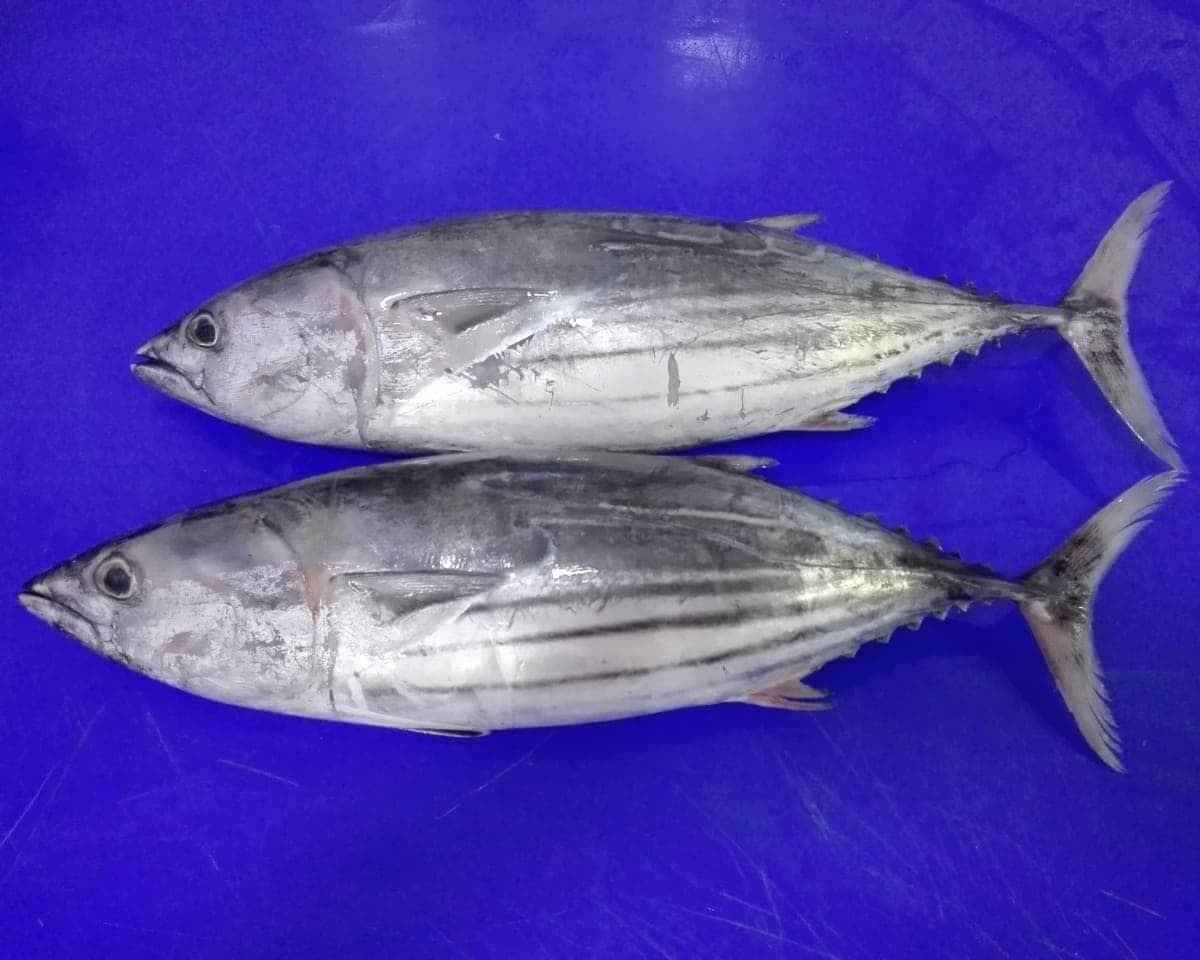
- Skipjack is identified by four to six dark stripes along the belly and a plain, unmarked back.
- “Bonito” properly means Sarda; the “bonito flakes” of Japanese cooking are skipjack, so name the species on every document.
- Most skipjack comes from purse-seine fisheries managed by WCPFC, IATTC, IOTC and ICCAT, with pole-and-line and small-scale fisheries alongside.
- Purse-seine lots can contain juvenile yellowfin and bigeye, so agree a species tolerance and check it on arrival.
What skipjack tuna is and how to recognize it
Skipjack belongs to the Scombridae, the family of tunas, bonitos and mackerels, and it is the only species in the genus Katsuwonus. The body is a compact torpedo with a dark purplish-blue back and silvery lower sides. The surest field mark is on the belly: four to six bold dark stripes run lengthwise from behind the pectoral fin toward the tail, and on live fish they can look like rows of dark blotches. The back above them carries no bars or spots.
Two anatomical details separate it from the larger Thunnus tunas. Skipjack has no swim bladder, and apart from the corselet, a band of larger scales around the head and pectoral fins, and the lateral line, its skin carries no scales at all. The two dorsal fins sit close together, followed by a row of small finlets running to the tail.
The FAO species catalogue for scombrids gives a maximum of about 108 cm fork length and roughly 34 kg, but fish in commercial catches seldom exceed 80 cm, and the whole fish bought by canneries mostly weigh a few kilograms. Skipjack matures at around 45 cm and spawns in batches throughout the year in equatorial waters, over a shorter warm season farther from the equator. FishBase gives a maximum reported age of 12 years.
It is an oceanic fish of the upper water layers, found in tropical and warm-temperate seas around the world except the Black Sea. Schools travel with seabirds, whales, sharks and other tunas and gather beneath drifting logs and debris, a habit that fishers exploit with fish aggregating devices, or FADs. Skipjack eat small fish, crustaceans and squid, and are themselves hunted by larger tunas and billfishes.
Skipjack look-alikes: small tunas, bonitos and juvenile yellowfin
Several smaller scombrids share skipjack’s size and coloring, and on a sorting belt or in a purse-seine haul they are easily mixed up. The belly stripes remain the quickest check, read together with the markings on the back.
| Fish | Scientific name | Field marks | Why it matters in trade |
|---|---|---|---|
| Skipjack tuna | Katsuwonus pelamis | 4–6 dark stripes along the belly; plain back without stripes or spots | The reference species for canning-grade raw material |
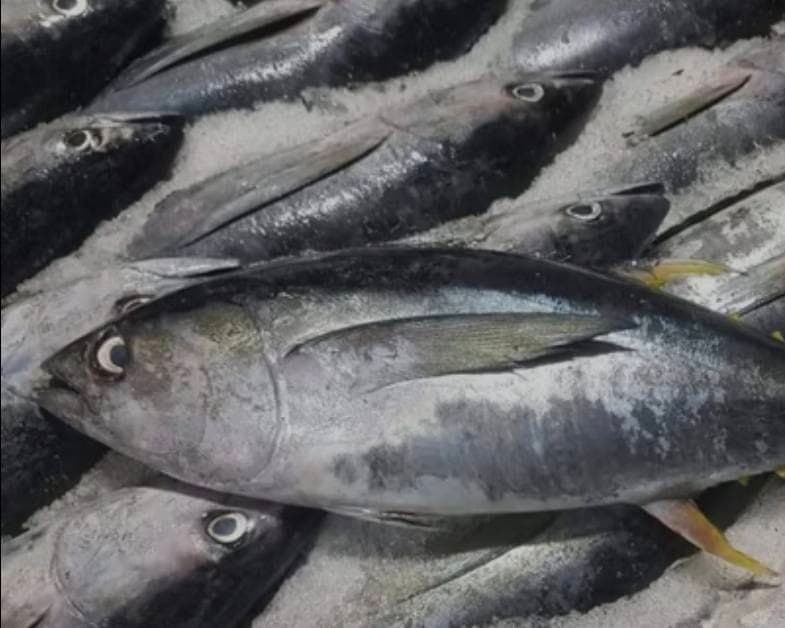
| Yellowfin tuna, juvenile | Thunnus albacares | No belly stripes; broken vertical lines on the lower sides; yellow finlets edged in black | Caught with skipjack in purse-seine sets, especially around FADs |
| Bigeye tuna, juvenile | Thunnus obesus | Deeper body and larger eye than a yellowfin of the same size; fine striations on the underside of the liver | Hard to separate from small yellowfin without internal checks |
| Kawakawa and little tunny | Euthynnus affinis, E. alletteratus | Wavy or broken stripes on the back only; a few dark spots between the pectoral and pelvic fins | Mostly coastal fish, landed in mixed small-scale catches |
| Bonitos | Sarda spp. | Dark stripes running along or slanting across the back, none on the belly | The fish that the English name “bonito” properly describes |
The juvenile tunas matter most. Purse-seine sets, particularly those made on FADs, take small yellowfin and bigeye along with skipjack, and at a few kilograms the two Thunnus species are difficult to tell apart even for experienced sorters. Catch documents and labels record the catch by species, so lots sold as skipjack should be checked for these fish. Our yellowfin tuna species guide sets out how yellowfin, bigeye and albacore differ once they are grown.
Skipjack names: katsuo, aku, listado and the bonito problem
Few seafood names cause as much confusion as “bonito”. In English the word belongs to the genus Sarda, yet the Japanese katsuo is routinely translated as bonito, which is why packets of shaved katsuobushi made from skipjack are sold abroad as “bonito flakes”. Older English names for skipjack include oceanic bonito and striped tuna.
| Language or market | Name | Note |
|---|---|---|
| English (FAO) | Skipjack tuna | Oceanic bonito and striped tuna in older or regional use |
| French (FAO) | Bonite à ventre rayé | FAO gives listao as an equivalent name |
| Spanish (FAO) | Listado | Barrilete is used in Mexico and Chile |
| Japanese | Katsuo | The smoked and dried product is katsuobushi |
| Hawaiian | Aku | Not to be confused with ahi, which Hawaii uses for yellowfin and bigeye |
| Indonesian | Cakalang | The usual Indonesian market name |
| Maldivian (Dhivehi) | Kalhubilamas | The cured product, valhoamas, is sold abroad as Maldive fish |
On canned tuna, US rules reserve the color designation “white” for albacore (Thunnus alalunga), so skipjack, like yellowfin, is packed as light tuna when its color qualifies. The same US standard admits more than a dozen species as canned tuna, which makes the species name on the specification the only reliable guide to what a can holds.
Where skipjack comes from and how the fishery is managed
Skipjack is fished in all three tropical oceans. The western and central Pacific supports the largest fishery, and there are major fisheries in the Indian Ocean, the eastern Pacific and the Atlantic as well. Purse seiners take most of the catch, setting their nets either on free-swimming schools or around FADs. Pole-and-line vessels, which catch fish one at a time with live bait, remain important in the Maldives, Japan and parts of Indonesia, and trolling, gillnets and handlines supply small-scale fisheries across the tropics.
Industrial catches are frozen in refrigerated brine in the vessel’s wells, then landed or transshipped to processing centers. Thailand, and the Bangkok area in particular, is one of the largest of these. Loins cooked and cleaned there and in other processing countries travel on to canneries in Europe and elsewhere that fill cans close to their markets, while Japanese katsuobushi makers buy frozen whole fish.
Each ocean’s stocks fall under a regional tuna commission: the Western and Central Pacific Fisheries Commission (WCPFC), the Inter-American Tropical Tuna Commission (IATTC) in the eastern Pacific, the Indian Ocean Tuna Commission (IOTC) and, in the Atlantic, the International Commission for the Conservation of Atlantic Tunas (ICCAT). Their measures include registers of authorized vessels, limits on purse-seine effort, seasonal closures of fishing on FADs and rules on how many FADs a vessel may deploy. These measures are revised regularly, so check the current rules of the commission for the ocean where your fish was caught.
For importers, skipjack is documented like other wild-caught tuna, with vessel, ocean and gear named per lot and the catch certificates or import records your market asks for. Our guide to reefer shipping and the cold chain explains how the temperature records that go with those shipments are kept.
Skipjack seasons and sizes in the trade
In the tropics skipjack is caught all year, and the supply of particular sizes moves with weather, ocean conditions and the seasonal FAD closures. Japan adds a seasonal layer of its own. Skipjack moving north along Japan’s Pacific coast in spring are sold as hatsugatsuo, the first katsuo of the year, prized for a lean, clean taste; in Kochi Prefecture the spring fish are in season from about March to May. Fish heading south again in autumn, modorigatsuo, carry far more fat and are valued for their richness.
Whole frozen skipjack is bought by individual fish weight, because both the yield of loin meat and the speed of a canning line depend on size. The product page lists the bands we work with, from about 1.4 kg up to fish over 3.4 kg, along with loin and steak formats.
Market forms and how kitchens use skipjack
- Whole round, brine-frozen: raw material for canneries, loining plants and katsuobushi makers.
- Precooked loins: steamed, skinned and cleaned of bone and dark meat, ready to be filled into cans and pouches at destination.
- Raw loins and steaks: for searing, grilling and tataki-style dishes.
- Canned and pouched light tuna: the largest retail use, packed in water, brine, oil or sauces.
- Katsuobushi: fillets boiled, smoked and dried rock-hard; the premium honkarebushi is also ripened with mold over several months before it is shaved.
- Maldive fish: loin pieces boiled, smoked and sun-dried until hard, then flaked or pounded as a seasoning.
- By-products: heads, frames and trimmings from loining, which feed into fish processing by-products such as meal and oil.
In Japan, fresh skipjack in season is eaten as sashimi or as katsuo no tataki, a specialty of Kochi: the skin side of a loin is seared over a fierce flame, traditionally burning straw, chilled quickly and sliced thick with aromatics. Katsuobushi, shaved into fine flakes, is the base of dashi, usually paired with kombu, and is scattered over chilled tofu, okonomiyaki and blanched greens.
In the Maldives, where the cured fish is called valhoamas, pounded pieces season mas huni and go into curries and the fried dumplings called gulha. Sri Lankan cooks know it as umbalakada and use it to thicken and flavor vegetable curries and pol sambol, the coconut relish.
Elsewhere skipjack reaches the table mainly through the can, in salads, sandwiches, pasta, rice dishes and ready meals. Raw skipjack meat is darker and softer than yellowfin, with a fuller flavor, so cooks who sear or grill it keep the cooking brief and lean on acidic or salty seasonings. Thawed fish should go from the refrigerator straight to the pan, since histamine forms quickly in tuna left warm.
Quality checks and labeling points for skipjack buyers
Skipjack quality is decided mostly between the net and the freezer. Fish brined and frozen quickly keep firm flesh and intact bellies, while delays, overfilled wells or rough handling show up as burst bellies, crushed fish and higher histamine results that no later step can undo. Long contact with the brine also draws salt into the meat, which canners control through a salt limit in their specification. On arrival, buyers usually check:
- Species mix, with a written tolerance for juvenile yellowfin and bigeye in lots sold as skipjack
- The share of fish that fall inside the agreed weight band
- Belly integrity, crush damage, skin and eyes after thawing
- Salt taken up from the brine, measured on sampled fish
- Histamine results matched to the lot code on the cartons
Mackerels share skipjack’s family and many of its handling needs, and the mackerel species guide explains how the different fish sold under that name are told apart. When you are ready to source skipjack, send us your weight bands, formats and destination and we will match lots to them.
This guide is general trade information, not legal or regulatory advice. Requirements differ by market and change over time; confirm current rules with your customs broker or competent authority before ordering.