Black tiger shrimp is the one people picture when a menu promises something large and striking: a heavy body, dark bands across the shell and, once cooked, bold red and cream stripes. FAO calls it the giant tiger prawn, and its scientific name is Penaeus monodon. It was the species that built Asian shrimp farming in the 1980s and 1990s, and it remains the premium farmed shrimp beside the far more plentiful whiteleg.
This profile covers the animal: how to recognize it, its names, range and life cycle, how farming developed and works today, where wild tiger still comes from, which prawns resemble it, and how kitchens use it. BSA supplies farmed black tiger shrimp from South and Southeast Asia, and the largest head-on grades are also offered through our large shrimp and prawns program.
Key takeaways
- Black tiger shrimp, giant tiger prawn, ushi-ebi and bagda chingri all name one species, Penaeus monodon, a large penaeid of the Indo-West Pacific.
- Raw tiger shows blue-black and yellow bands that cook to red and cream, but other banded prawns also carry the “tiger” name, so check the scientific name.
- Most supply is pond-farmed in South and Southeast Asia, often in low-density tidal systems, so sizes are less uniform than in whiteleg shrimp.
- Tiger earns its premium where the shrimp is seen whole or served large; whiteleg covers the volume dishes.
How to recognize a black tiger shrimp
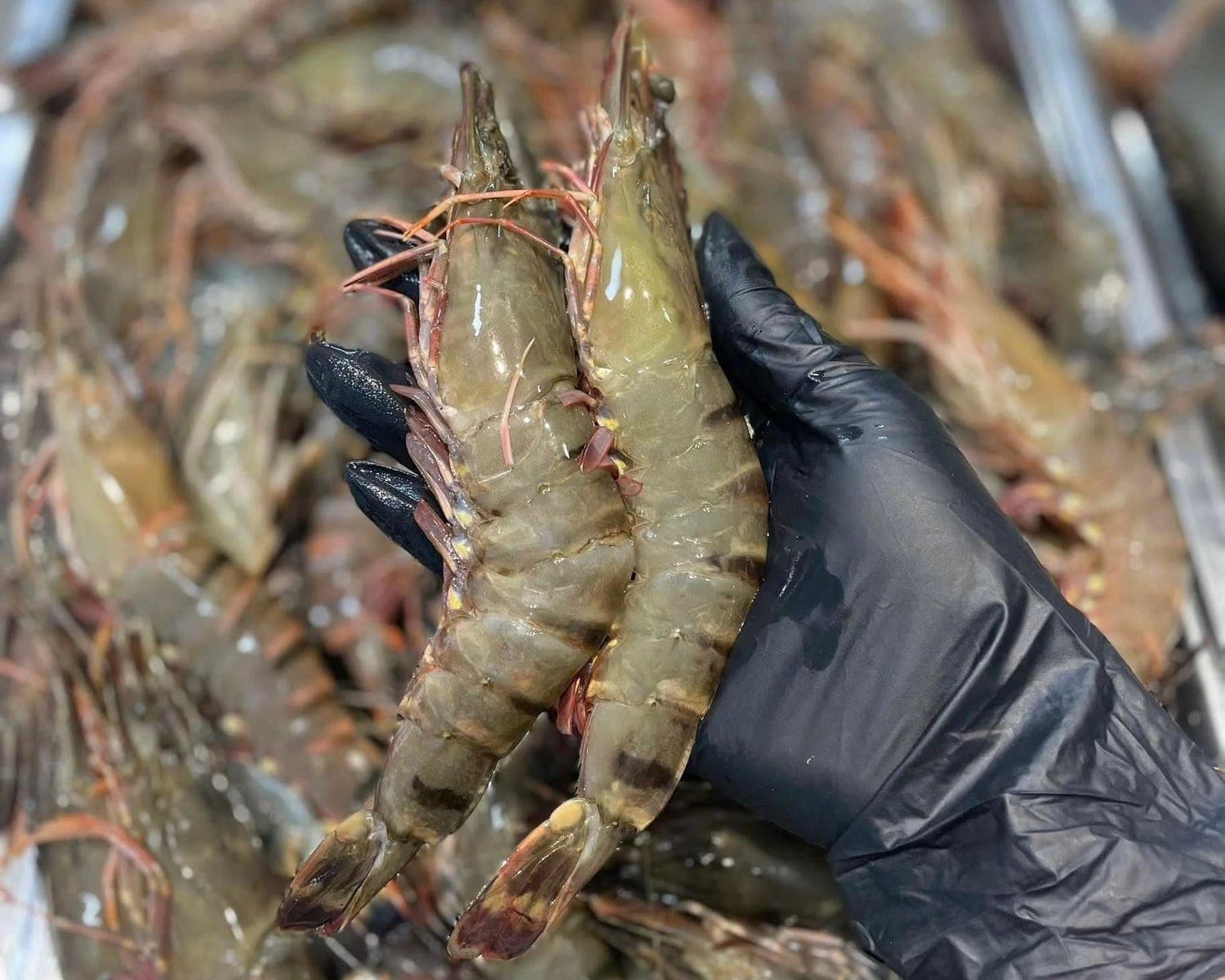
Penaeus monodon is a large, heavy-bodied penaeid with its shell banded from head to tail. FAO describes a variable base color, green, brown, red, gray or blue depending on the pond bottom, feed and water, crossed by alternating bands of blue or black and yellow. Heat turns the dark bands a vivid red against cream, the look that makes it a centerpiece on grills and platters.
- Size: adults can reach about 33 cm, and females outgrow males; wild females used as hatchery broodstock commonly weigh 200 to 320 g, males 100 to 170 g.
- Identification details: specialists confirm the species by features such as a straight, horizontal ridge (the hepatic carina) on the side of the carapace and the lack of a small outer branch on the fifth pair of legs.
- Habit: a burrower that buries itself in the bottom by day and feeds at night, more of a predator than most penaeid shrimps.
| Name | Language or market | Notes |
|---|---|---|
| Giant tiger prawn | FAO English name | Widely used in Asia and Australia |
| Black tiger shrimp or prawn | International frozen trade | The usual name on cartons and offers |
| Jumbo tiger prawn | Australia, India and the Philippines | A regional vernacular name |
| Ushi-ebi | Japan | Literally “cow prawn” |
| Kung kula dam | Thailand | “Dam” means black |
| Bagda chingri | Bangladesh and West Bengal | Bengali; golda chingri is the freshwater prawn |
| 斑节对虾 | China | Mandarin name |
| Crevette géante tigrée | French (FAO name) | Literally “giant tiger shrimp” |
| Gambero gigante indopacifico | Italy | Official Italian trade name |
Where black tiger shrimp lives in the wild
The species is native to the Indo-West Pacific, from East Africa and the Arabian Peninsula through South and Southeast Asia to northern Australia and the western Pacific. Adults live offshore over muddy sand or sand, usually at 20 to 50 m. Mating takes place at night, just after the female molts, and a large female can release 500,000 to 750,000 eggs into the sea; the larvae drift shoreward, and juveniles grow up in estuaries, lagoons and mangroves, where they tolerate water that is almost fresh.
Farm escapes have turned up well outside that range. Wild populations are thought to have become established along parts of West Africa, on the northern coast of South America and in the Caribbean, and in the United States the species has been recorded from North Carolina to Texas since an escape from a South Carolina farm in 1988. Within the native range, wild females are also caught for hatcheries, which prefer animals taken in deeper water far offshore, where shrimp diseases are less common than near the farming coasts.
How black tiger shrimp is farmed
Tiger shrimp were raised long before hatcheries existed. Coastal farmers in South and Southeast Asia stocked tidal ponds with wild-caught juveniles, and the species was also a valuable by-product of extensive milkfish ponds. Breeding research in Taiwan and Tahiti in the early 1970s, and the first breeding success at Thailand’s Phuket Fisheries Station in 1972, led to monoculture. Through the 1980s small intensive farms in Taiwan grew tiger for Japan until a disease outbreak, thought to be viral, brought that industry down in 1987–88, after which Thailand became the leading producer and farming spread across the region.
From the early 2000s, whiteleg shrimp took over many Asian farms that had raised tiger, Thailand’s and China’s among them. One contrast stood out: tiger hatcheries still depended mainly on wild-caught broodstock, while whiteleg came from domesticated, disease-screened lines. Tiger is still widely farmed in countries such as Vietnam, Bangladesh, India, Indonesia and Myanmar, where FAO describes extensive tidal-pond systems as common.
FAO describes commercial tiger culture as taking place in earthen ponds, at salinities anywhere from 2 to 30 parts per thousand. Extensive tidal ponds hold no more than two young shrimp per square meter, rely on natural food carried in by the tide and yield shrimp above 50 g after six months or more. Semi-intensive ponds, stocked at 5 to 20 per square meter and given supplementary feed, produce shrimp of 30 to 35 g, while intensive ponds hold 20 to 60 per square meter under heavy aeration and run crops of four to five months.
In traditional ponds, bamboo traps pick out the largest shrimp for partial harvests; elsewhere ponds are drained through a bag net on the tide and the last shrimp are gathered by hand from the mud. That mix of systems is why tiger lots vary more in size than intensively farmed whiteleg. Wild tiger, from coastal trawl and artisanal fisheries across the range, reaches very large sizes and is sold separately, labeled as wild.
Black tiger compared with whiteleg and other banded prawns
| Feature | Black tiger shrimp | Whiteleg shrimp |
|---|---|---|
| Scientific name | Penaeus monodon | Penaeus vannamei |
| Native range | Indo-West Pacific, East Africa to Australia | Eastern Pacific, Mexico to northern Peru |
| Maximum size | About 33 cm, females larger | About 23 cm, females larger |
| Raw appearance | Blue-black and yellow bands over a variable base color | Translucent white to gray, no strong bands |
| Typical farming | Earthen ponds, from tidal extensive systems to intensive | Semi-intensive to intensive ponds, often at high density |
| Broodstock | Long reliant on wild-caught females | Domesticated, disease-screened lines |
| Eating quality | Firm, meaty bite and fuller flavor | Tender, mild and lightly sweet |
| Typical role | Whole and head-on presentation, large peeled sizes | Volume peeled, cooked and coated products |
Several other banded prawns share the “tiger” label, which is why Penaeus monodon should be named on offers and labels:
- Green tiger prawn (Penaeus semisulcatus): an Indo-West Pacific species known in Japan as kuma-ebi, with a smaller maximum size than black tiger.
- Brown tiger prawn (Penaeus esculentus): an Australian species often called simply tiger prawn at home, so an Australian “tiger prawn” is not automatically P. monodon.
- Kuruma prawn (Penaeus japonicus): a banded prawn prized in Japanese cooking and traded under its own name.
For the pale species on the other side of this comparison, see our whiteleg shrimp profile and the farmed vannamei shrimp BSA supplies in standard cuts.
Sizes and market forms of black tiger shrimp
Size is what tiger sells on. The biggest head-on grades run to only a few pieces per kilogram and headless counts go below ten per pound, sizes that whiteleg seldom reaches. The main forms are:
- Head-on, shell-on: often block-frozen with the shrimp laid in rows, for grilling and whole presentation.
- Headless shell-on and EZ-peel: for barbecues, boiling and shell-on curries.
- Peeled, butterflied and nobashi: for tempura, frying and plated mains where a large, straight shrimp matters.
- Cooked: head-on or peeled tail-on, chilled for buffets and cocktail service.
- Value-added: tempura, dumplings, skewers and breaded lines, many of them processed in Thailand.
A small live trade also exists, mainly supplying Chinese restaurants, with some exports to Hong Kong and mainland China. For the count notation, glaze and arrival checks that apply to every frozen tiger shipment, see our guide to frozen shrimp count and glazing.
Cooking with black tiger shrimp
Tiger has a firmer, meatier texture than whiteleg and a fuller flavor. Large pieces give a cook a little more margin on the grill than small shrimp do, but they still toughen when overcooked, and the head adds depth to sauces and curries when the shrimp is cooked whole.
- Bengal: chingri malaikari, a coconut-milk curry classically made with the freshwater golda chingri described in our giant freshwater prawn profile, and also cooked with tiger prawns, locally bagda chingri.
- Japan: large headless tiger has long been a mainstay of the Japanese market, battered as tempura or crumbed as ebi fry.
- Southeast Asia: grilled whole over charcoal, stir-fried in the shell with garlic and pepper, or added to tom yum and curries.
- China and Hong Kong: steamed with garlic and glass noodles, or flash-fried in the shell for banquets.
- Western menus: skewered and grilled, served cold as cocktail shrimp, butterflied for the barbecue or tossed through pasta.
As with any raw shrimp, cook it through to the temperature your local food-safety rules set. When a menu calls for a particular head-on grade or peeled size, our team can work up an offer for that grade from current harvests.
This guide is general trade information, not legal or regulatory advice. Requirements differ by market and change over time; confirm current rules with your customs broker or competent authority before ordering.