Swordfish (Xiphias gladius) is a large, solitary predator of the open ocean and the only living member of its family, the Xiphiidae. Its long, flat bill gives it its name, and its dense, meaty flesh has made it a classic grilling fish of the Mediterranean, North America and Australia. We supply frozen swordfish as loins, steaks and portions from longline fisheries.
This profile looks at the fish itself: the anatomy that sets it apart from marlins, its unusual biology, the names it carries in different markets, where and how it is caught and managed, the cuts it reaches buyers in, how it is cooked, and how to tell its steaks from the shark meat that is sometimes sold in its place.
Key takeaways
- Swordfish is the sole member of the Xiphiidae: a flat sword, no pelvic fins, and no scales or teeth in adults.
- It spends its days deep and its nights near the surface, which is why longlines targeting it often fish at night.
- ICCAT, IOTC, WCPFC and IATTC manage the stocks, and the trade carries ICCAT statistical documents plus EU and US import requirements.
- Flesh color varies from ivory to orange; judge the bloodline instead, and check skin, bone and muscle pattern to rule out shark.
How to recognize a swordfish
The bill is the obvious feature, but its shape is what matters. In a swordfish the upper jaw extends into a long, flat, sharp-edged sword, broad in cross-section, whereas marlins and sailfish carry a shorter, rounded spear. Adult swordfish also lack features those billfishes have: there are no pelvic fins, no scales and no teeth, the scales and teeth being lost as the young fish grows past about a meter. The first dorsal fin is tall, the eyes are very large, and each side of the tail stalk carries a single pronounced keel ahead of a broad, crescent-shaped tail.
The back is dark brown to black, shading lighter on the belly. Young swordfish look quite different from adults, with continuous dorsal and anal fins and scale-like skin structures, and change shape dramatically before they mature.
Swordfish are among the largest bony fish in the seafood trade. The longest on record measured 455 cm to the fork, and published maximum weights run from about 540 to 650 kg, but commercial fish are far smaller: NOAA puts the average North Atlantic fish at roughly 25 to 90 kg. Females grow faster and larger than males, so the biggest fish are nearly all female, and in Atlantic catches fish over about 225 cm are almost entirely female. Lifespan is usually given as 9 to 10 years, with tagging showing that some fish reach 15.
Swordfish biology: deep by day, shallow by night
Swordfish range through tropical and temperate waters of every ocean, roughly between 45°N and 45°S, and into the Mediterranean, the Sea of Marmara and the Black Sea. According to ICCAT, they tolerate a wider temperature range than any other billfish, from about 5 to 27 °C, and the largest individuals move into colder water than small ones.
Their daily routine is a vertical migration. Acoustic tracking has shown swordfish staying near the surface at night and descending to around 600 m during the day, where they hunt fish and squid in deep, cold, dark water. A specialized heat-exchange system warms the eyes and brain by 10 to 15 °C above the surrounding sea, sharpening their vision for moving prey. The sword is used in feeding: prey are often found with slash marks, and swordfish have been seen striking into schools of fish.
Tunas are rich in myoglobin-laden red muscle built for constant cruising, while swordfish carry a larger share of white muscle suited to sudden bursts of speed. Adults are mostly solitary and gather mainly around spawning, which takes place in warm waters, in the western Atlantic south of the Sargasso Sea and in the upper Caribbean, and in the Mediterranean around the Balearic Islands among other areas.
Swordfish names around the world
| Market or language | Name | Note |
|---|---|---|
| English | Swordfish; broadbill | Broadbill is common in the US, Australia and New Zealand |
| French | Espadon | ICCAT standard name |
| Spanish | Pez espada | Spain also uses emperador |
| Chile | Albacora | Not albacore tuna; pez espada is used too |
| Italian | Pesce spada | Many regional forms in southern Italy and Sicily |
| Portuguese | Espadarte | Brazil also uses meka |
| Japanese | Mekajiki | Often shortened to meka |
| Hawaii | Shutome (market name); a’u (Hawaiian) | Mekajiki and broadbill are also used |
| Greek and Turkish | Xifias; kılıç balığı | Both names come from words for sword |
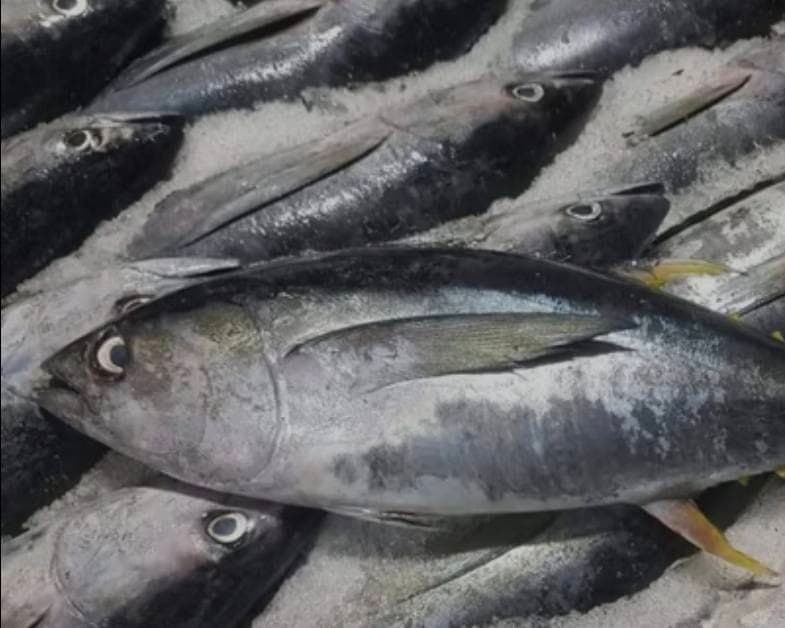
The Chilean albacora is worth remembering, because almost everywhere else the same word names a tuna. The yellowfin tuna species guide untangles the tuna side of that name.
Where swordfish is caught and how the stocks are managed
Pelagic longline is the main gear worldwide, often set so that the baited hooks fish through the night, when swordfish come up toward the surface. Harpoon fishing, practiced in the North Atlantic since the late 19th century, survives in a few places alongside handline, rod-and-reel and buoy gear, and swordfish are also taken incidentally in other pelagic fisheries. There are important fishing grounds in every ocean; our own frozen supply comes mainly from Indian Ocean longline fleets.
Swordfish falls under the same regional bodies as the tropical tunas. ICCAT treats the Atlantic as three management units, North Atlantic, South Atlantic and Mediterranean, while IOTC covers the Indian Ocean and WCPFC and IATTC share the Pacific. Measures include catch limits, minimum sizes and, in some areas, closed seasons and gear rules. In US waters, for example, North Atlantic swordfish fishing requires permits and operates under annual catch limits, minimum sizes and reporting.
Trade paperwork is heavier than for most fish. ICCAT has run a swordfish statistical document program since 2002, the EU requires a catch certificate validated by the flag state, and in the United States swordfish falls under the Seafood Import Monitoring Program. Requirements are updated regularly, so confirm the current set for your market with your customs broker before shipment.
Swordfish cuts and what they are used for
Whole swordfish are dressed at sea or at landing, with the head, bill, guts and fins removed, and the trunk that remains is traded by dressed weight. Four long loins come from each trunk and are frozen skin-on to protect the meat, and steaks and portions are cut from the loins.
- Bone-in center-cut steaks: cut across the whole trunk, showing the backbone and four muscle quarters; the traditional fishmonger’s steak.
- Boneless steaks and portions: cut from loins to set thicknesses or ounce bands for restaurants and retail.
- Chunks and cubes: for skewers and kebabs.
- Smoked swordfish: sliced paper-thin, especially in Italy, for antipasti and carpaccio-style plates.
- Sashimi: in Japan, where mekajiki is also cooked as teriyaki.
Raw swordfish ranges from white and ivory through pink to orange, depending largely on diet and fishing ground, and it cooks to beige. Color on its own says little about eating quality; the bloodline is the better guide, bright red in well-kept fish and brown as it oxidizes. NOAA describes the meat as firm and moist with moderate oil and a slightly sweet taste.
How swordfish is cooked
Swordfish behaves more like meat than like flaky white fish, and kitchens cook it accordingly. Steaks at least 2.5 cm (an inch) thick are grilled or seared over high heat and taken off as soon as they are cooked through, because the lean center dries if left too long, and marinades of olive oil, lemon, herbs, soy or miso protect the surface. Cubes hold firmly on skewers, and the dense flesh takes smoking, poaching and braising without falling apart.
Sicily and southern Italy have a long swordfish tradition: thin slices rolled around breadcrumbs, pine nuts and raisins as involtini, steaks braised with tomato, capers and olives, and smoked swordfish carpaccio. Spanish cooks grill it a la plancha as emperador or pez espada, and Japanese kitchens use mekajiki for teriyaki and sashimi. In the United States and Australia it is a steakhouse and barbecue fish, served with salsas, flavored butters and charred vegetables.
Telling swordfish from marlin and shark
Whole fish are easy to separate, since only swordfish combine a flat sword, no pelvic fins and scaleless adult skin. Steaks are harder, and DNA studies of fish sold as swordfish in New England markets have found mako and thresher shark among the samples. A few physical checks help:
- Skin: swordfish skin is smooth, while shark skin feels rough, like sandpaper.
- Skeleton: a bone-in swordfish steak shows a true bony vertebra; sharks have cartilage instead.
- Muscle pattern: swordfish steaks show swirled, concentric muscle rings around the backbone, with a dark bloodline in each quarter.
- Marlin: whole marlin have a round spear, scales and pelvic fins; for skinless cuts, rely on documents and testing.
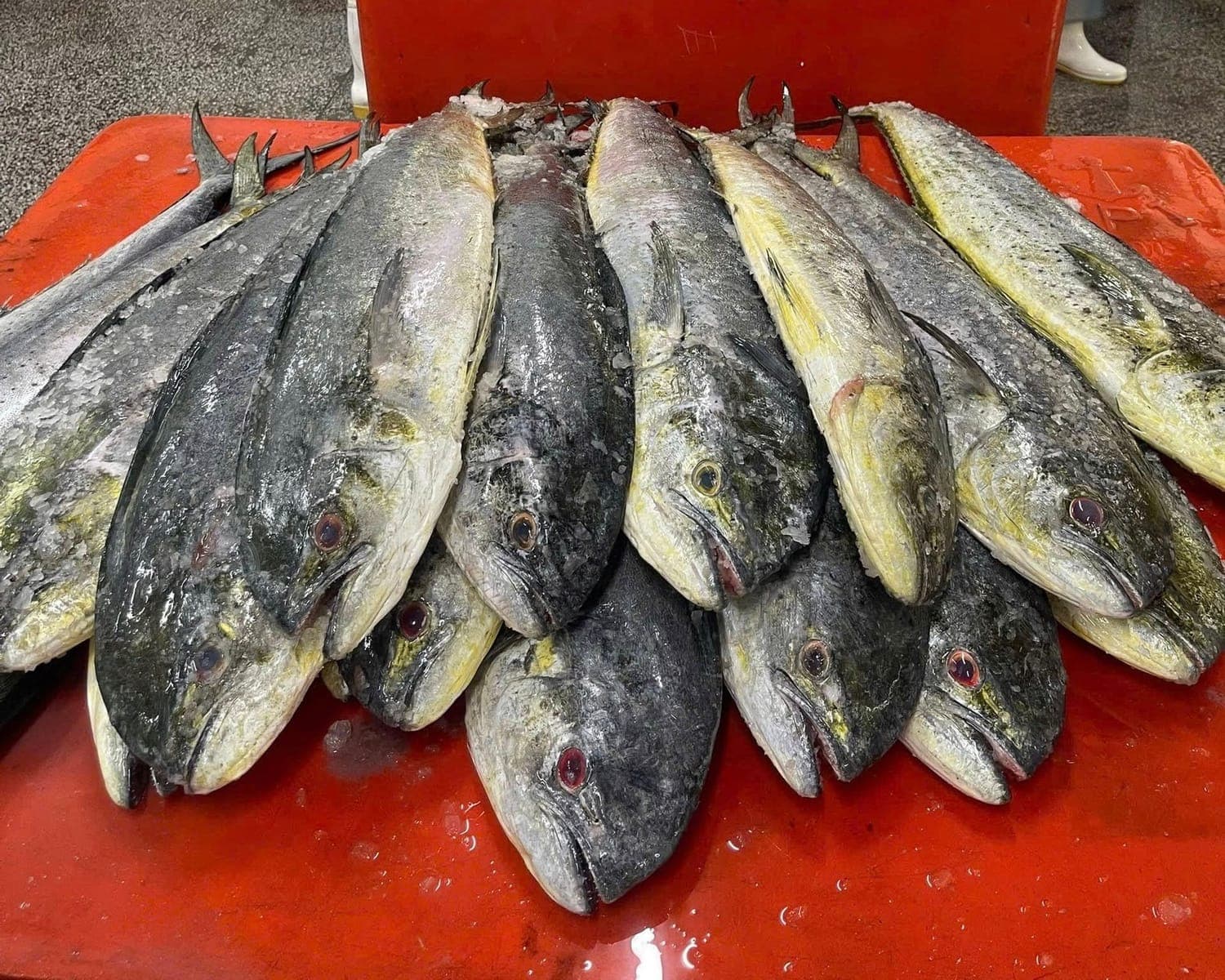
Many grill programs pair swordfish with frozen mahi-mahi and yellowfin tuna. The mahi-mahi species guide covers that fish, and our guide to choosing premium seafood ingredients explains how to match cuts to dishes. To plan a program, send us the cuts and ounce bands you need.
This guide is general trade information, not legal or regulatory advice. Requirements differ by market and change over time; confirm current rules with your customs broker or competent authority before ordering.